Andy Jamieson

Sometime Geek Overlord, bi-monthly Dungeon Master, part-time care worker, reigning Husband of the Year, & full-time daddy. Also, proficient proverbial juggler.

Mar 212012
 

Hmm, will we ever see this game released?


The Lost Guardian

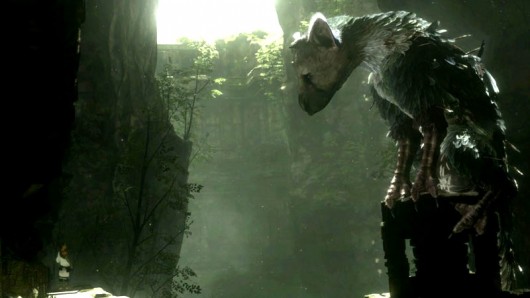
A single white feather floats in the darkness and alights next to a round stone structure which appears to be a well with a rusted chain disappearing into its depths. A blackbird lands on the structure, dwarfed by the seemingly huge white feather, caws and then flies away, startled as a giant creature with glinting eyes steps out of the shadows…

These are the opening seconds of a 2009 trailer for The Last Guardian, the third game from Sony’s own development team known as Team Ico, headed by Fumito Ueda. A game that has yet to be released.

Fans of developer Fumito Ueda are no strangers to patience. Early initiates into the cult of Ueda who picked up Ico for the PS2 in 2001 had to wait until October 2005 for spiritual successor / prequel Shadow of the Colossus. That said, when a third game was announced in 2008 (under the working title Trico) few expected that there would be no release in sight some 4 years later. There was a leaked trailer < http://www.youtube.com/watch?v=ATl4RHYHm0w> around May 2009, and then a slightly different (but better quality and official) version of the trailer < http://www.youtube.com/watch?v=T4E0e-ZCn14 >in June 2009 (originally shown at E3 that year). Speaking to Edge magazine in June 2009 about the leak of the “proof of concept” trailer, Sony Computer Entertainment Worldwide Studios boss, Shuhei Yoshida said: “I’d be lying if I said I wasn’t disappointed [about the leak]…. But the reason we didn’t show early footage was because the team wanted to feel comfortable that the vision they created could be delivered. So everything we showed here was from the game engine, and they’ve got to the point where they know they can make this game and can see how it’ll be completed.”

And then we had a shorter trailer (originally shown at the 2010 Tokyo Game Show) <http://www.youtube.com/watch?v=CxXmZbU9ez0 > which ended with a tantalising “Coming Holiday 2011”.

And then there was silence.

And then came the news in November 2011 that Fumito Ueda had left Sony.

Which made fans anxious.

And then came the news a few weeks later that he was working on the game on a freelance basis.

Which made fans confused. What exactly was going on with The Last Guardian?

Some clarity was provided last month when Shuhei Yoshida gave an interview to gaming site 1Up < http://www.1up.com/news/shuhei-yoshida-last-guardian-update > .

So here’s what Yoshida had to say: “Fumito’s vision is really causing a very difficult challenge for the developers, so there’s some scrapping and rebuilding – iteration in the process. That’s why [it’s taking so long]”. No detail on what exactly the problems are, but my money is on the creature AI causing them grief, and I wouldn’t be surprised if they were also having trouble moulding a consistent and playable game around the unprecedented dynamic between playable character and a non-playable character AI which happens to be a 10 metre tall baby griffin / bird-kitten creature.

“Scrapping and rebuilding” are worrisome words, but I’d rather see them get this right than rush it out half-finished or imperfect. Of course this might mean that the final game differs somewhat from the trailers that we have seen so far, but then SOTC wasn’t quite the game that the proof of concept trailer for Project Nico (as it was originally known) indicated it would be. Check that out here <http://www.youtube.com/watch?v=eMARK1AsJ6A > if you haven’t already seen it.

Ueda’s followers will also take some comfort from Yoshida’s statements that the contractual status of the Man with the Vision may have changed, but he is working on this title every day, and putting in some long hours on it. Which can only be good news.

What the reasons were for the change in Ueda’s contractual relationship with Sony, and whether it is connected to the slow development of The Last Guardian, we will probably never know. What we do know is that work on the game continues, and that Fuimito Ueda, who has transported us to lands ancient and mysterious in two compelling and haunting games, still has a guiding hand over the project.

And so the faithful wait.

For myself, I missed Ico first time round and only caught up with it on the recommendation of our friendly neighbourhood Geekzine editor in 2005, but the combined allure of Ico and SOTC induced me to buy a second hand PS2 just so that I could play these wonderful games. If you haven’t played them, don’t worry. Just go out a buy a PS3 and the HD double-pack reissue, and prepare to fall in love. And then one day, possibly, hopefully, you will wake up to the news that The Last Guardian has a release date and you, and everyone else in the cult of Ueda will breathe a sigh of relief, mutter a prayer of thanks, and pre-order a copy immediately.


Jonny M.
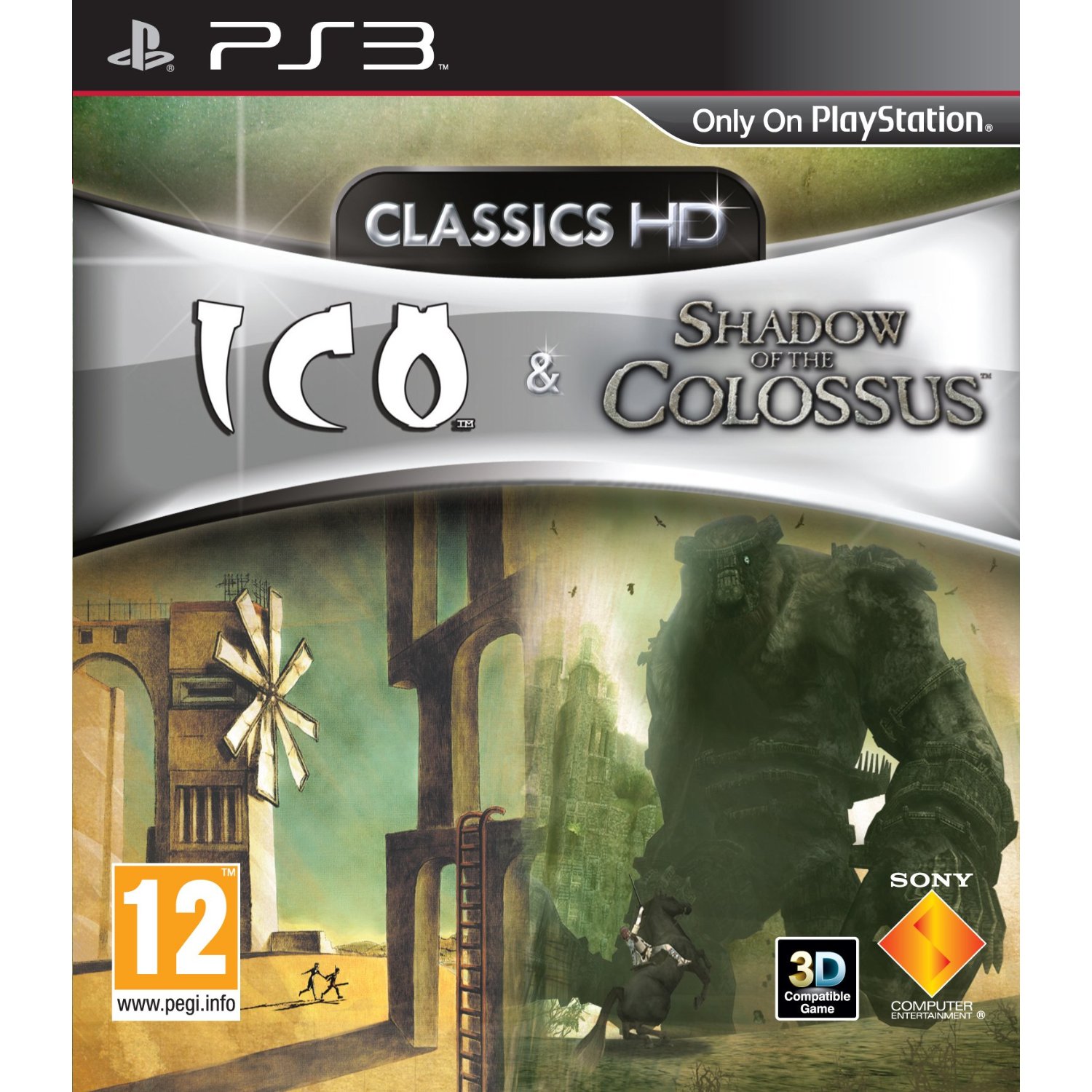
 

Ico & Shadow of the Colossus collection is available exclusively on the PlayStation3 for approximately £30. 
Mar 152012
 

Dan Abnett is an author whose name is synonymous with Science-Fiction and future war – be it 2000AD, Gaunt’s Ghosts, the Horus Heresy, Eisenhorn, Ravenor, Doctor Who, Torchwood…

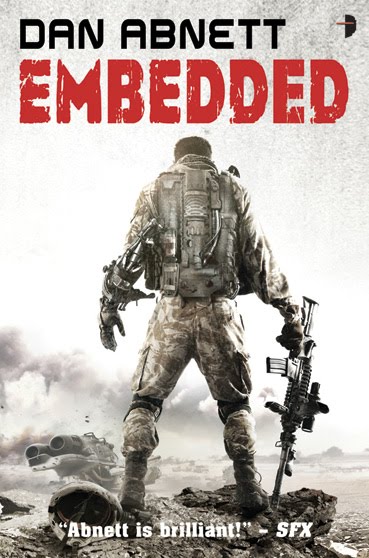
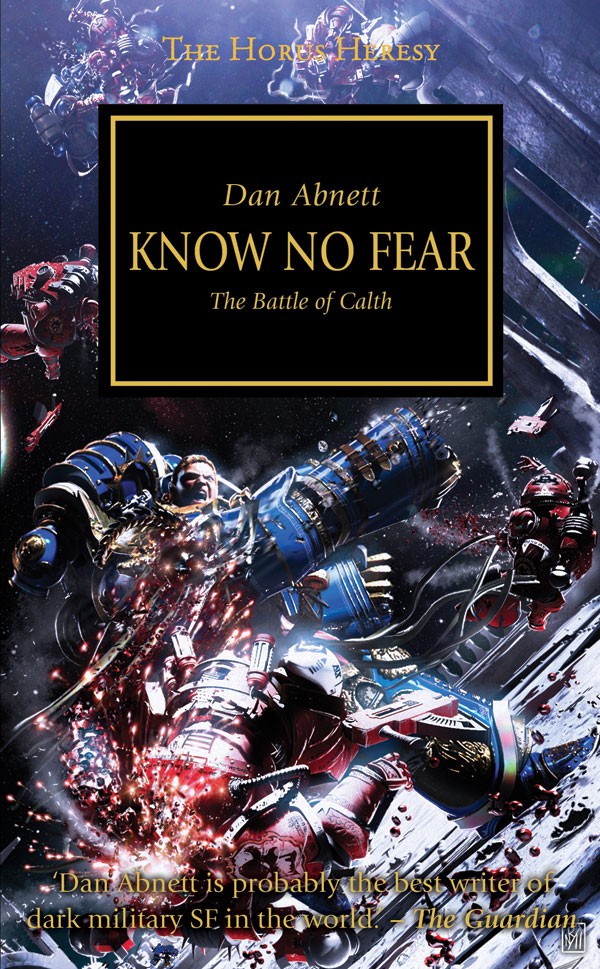
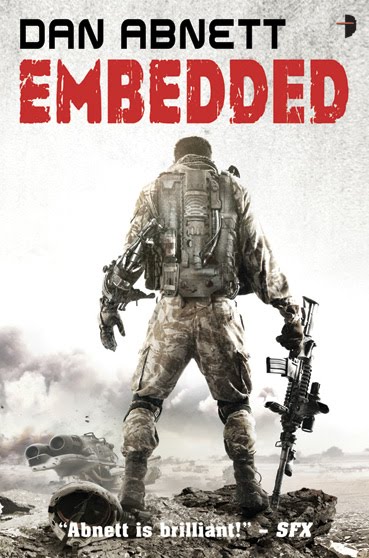
And he keeps going. His most recent book is Know No Fear (out now from the Black Library in paperback, £7.99), the nineteenth book in the ongoing best-selling Horus Heresy series, and depicts the pure bloody carnage of the Warhammer 40K universe’s defining civil war; this time around Abnett is focused on the invasion of the planet Calth by the Word Bearer’s Legion, and their ambush of the Ultramarines. Also out in paperback at £7.99 is Embedded, Abnett’s second novel for edgy indie publisher Angry Robot. Embedded is a stunning novel, tackling themes that Philip K. Dick would be proud. It charts a future ‘cold war’ between two military powers, on an obscure planet, with a veteran journalist caught in the middle. And it is fantastic and you should buy it at the first opportunity.

Dan took some time out from his hectic schedule to answer some questions for the geekzine.

Andy, Editor


Andy Jamieson: Embedded has such an intricate SF plot with loads of detail crammed in; did it take some planning and preparation, or was it a quick turnaround from idea to finished book?

Dan Abnett: I’d actually had the idea festering for a year or two before I wrote it, maybe longer, but the actual brain-to-page process was quite rapid. Once I started writing it, I worked out, and made sense of, all the little devices and ideas I’d hoped to include. So the writing and the sharp focus of realization came in a rush: but the general idea had been brooding for a while.


AJ: Know No Fear is your fourth Horus Heresy novel – what new challenges did this instalment present you, compared to the others?

DA: I wanted to kick more ass than had ever been kicked before. Basically, this one is wall-to-wall, top-of-your-lungs, maximum-impact action. Prospero Burns (the previous one) was also about a big battle, but I spent time explaining why it happened rather than showing what happened. Most people loved it (enough to put it on the NYT bestseller list), but some folks said they were expecting more action. So I thought, right…. you want action? I even shifted the whole book into the present tense to make it even MORE in your face.

AJ: What sort of research does a series like Gaunt’s Ghosts require? Obviously you have to be familiar with the Warhammer 40K universe, but did you also study any real-life military operations in preparation for writing the books?

DA: Yes, a lot. I talk to serving and retired servicemen too. I’ve made a lot of friends that way – a lot of people in the armed services read books like Gaunt, which is flattering and sometimes puzzling (seeing as I’m a professional maker-up-of-things). My basic aim is to make each Gaunt book have its own flavour, in terms of setting, theatre, and type of operation, without – of course – having them do things that an infantry regiment plainly wouldn’t do. So I look at the history of war, and at all the different ways ‘infantry’ have been used in different places at different times.

AJ: As an author who writes both prose and comic scripts, do you feel the need to keep a balance between the two? Does one usually take precedence over the other?

DA: I wrote comics first, then novels came along. I’d always wanted to write both, so I didn’t want to stop writing either. Switching between the two forms keeps me engaged and fresh. It’s nice to write a comic script, which might be complete in a few days, and get a satisfying sense of closure, to offset the long, exacting process of a novel.

AJ: Following on from the Ultramarines movie, have you been approached to write anymore Warhammer 40K movies, or film scripts in general? And how was the experience of working on the Ultramarines movie?

DA: Working on the movie was very enjoyable, and was a brilliant learning experience in terms of what writing for the screen involves. The film had bad press from some quarters. I think they did a pretty good job, given the limitations (like they had a budget that would have just about financed a single cutscene in a game). I think they deserve a proper round of applause for a valiant first foray into 40K on film.

I am working on other screen projects. I’m just not allowed to talk about them yet.

AJ: How far ahead do you plan your writing projects, and what are you currently working on?

DA: Comics are roughly planned six months or a year in advance. Books are set up two or three years in advance. I think I know what I’ll be writing next year and the year after. Right now, I’m writing Pariah, the first of the Bequin Trilogy, the long awaited follow up to the Eisenhorn and Ravenor trilogies. After that, another Horus Heresy novel called The Unremembered Empire, then the next Gaunt (“Warmaster”). In comics, I’m working on Resurrection Man for DC, New Mutants for Marvel, The New Deadwardians for Vertigo, and the forthcoming Hypernaturals for Boom! Plus Sinister Dexter and Grey Area for 2000AD.

AJ: You are an incredibly prolific author, who works to a consistently high standard; what’s your secret?

DA: I work relentlessly. I am very disciplined. I like what I do, which makes it easier to work stupidly long hours. But I’m a ruthless taskmaster. I don’t take any shit from myself. I get on with it. It’s what I do, so I take it seriously.


Many thanks to Dan for his time, and to Jim Taylor for helping put together the questions.

Andy Jamieson

ps – check out Dan’s website – www.danabnett.com – for all your Abnett awesomeness.

Mar 092012
 

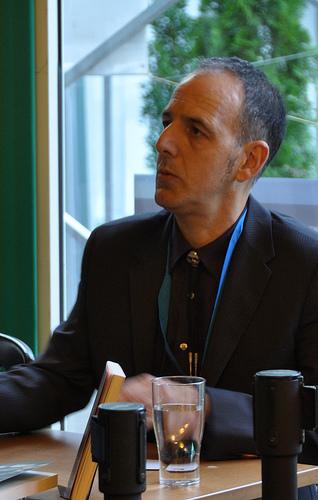
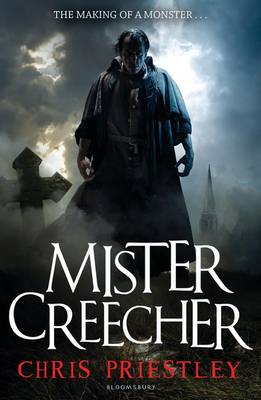
Chris Priestley (pictured above at a book festival last year) is the extremely talented author of the Tales of Terror series (Uncle Montague’s Tales of Terror, Tales of Terror from the Black Ship, and Tales of Terror from the Tunnel’s Mouthplus the very rare The Teacher’s Tales of Terror for World Book Day 2011), and the novels The Dead of Winter, and now the excellent Mister Creecher, just out in paperback (Bloomsbury, £6.99). If you haven’t heard of him, then now is as good a time as any to get educated; start with the Tales of Terror first, then onto the novels – you will not be disappointed. Priestley is to our generation what Edgar Allen Poe was to his; a literary genius of the horror genre. You will find Chris’ books in the Young Adult / Teenage section of your local bookshop, but his works could (and should, in my opinion) also be found in the standard horror section.

To coincide with the release of Mister Creecher in paperback, Chris took time out from his busy schedule to answer my questions.

Andy Jamieson, Editor


What inspired Mister Creecher
It was mainly inspired by an enthusiasm for the original Mary Shelley version of the Frankenstein story, but it is also inspired by my love of that whole period – the Romantic poets and the artists like Caspar David Friedrich and Turner, who were working at the time.  Mainly, I have always been excited by the idea that Frankenstein and his creature came to Britain, travelled through London and Oxford and the Lake District, up through Scotland and to Orkney.  I think I have always wanted to write something in response to that, ever since I read the book in my teens.

Mister Creecher is arguably the most ambitious, most epic book you’ve written to date. Did you have all the details planned out in advance or were you surprised at how things developed as you wrote?
I’m pleased to hear you say it is ambitious, because I do feel that it is.  I set out to write something that responded to Mary Shelley’s novel in a thoughtful way, whilst retaining some of the themes of the Romantics.  Of course, none of that is as important as writing a compelling story and if the book is successful, it is because of that.  But if it sends the readers off to read Mary Shelley’s book or read a Keats poem then that would be great.  As for the plan, I do have to write a synopsis when I first pitch a book but this one was easy to pitch because the notion of revisiting Frankenstein had obvious appeal.  But like most of my work, and in common with most writers, ideas and details present themselves when writing. It is such a rich seam that I could have written half a dozen different novels, all of which would have taken it off in different directions.  It was a really enjoyable experience writing it and I hope that comes across.

Did you approach writing this book any differently than you did to any of your other works?
No, not really.  I did research the period.  I already knew a lot about Mary Shelley’s life because reading about her and her circle has been a bit of thing of mine for some time.  The more I read about the period, the more ideas that came to mind about what Billy and Mister Creecher would get up to.  I was very keen that this would not become an historical novel, even though it is – what I mean is that I did not want the history to be driving the plot.  I did not want it to be a history lesson by stealth.  Nothing – I hope – is wrong in the book, but it is set in the fictional world of the novel as much as the actual world of Regency England.  This is something I have been up to for a while now.  The Tales of Terror books are set in the world of Victorian and Edwardian ghost stories for instance.  The trick is to do all these things lightly when writing for this age group.  Otherwise you come off as a smart-arse teacher talking over their heads.  I’m sharing my enthusiasms as much as anything.  I drop clues to the stuff I’ve read and seen and if they are intrigued then good, but they can miss those things and still enjoy the book.

You are clearly a big fan of Mary Shelley’s Frankenstein. What is it about the original novel that you love so much?
Well I remember being absolutely blown away by it when I first read it.  The main revelation was the fact that the creature spoke, and looked so different from the movie version.  My advice to anyone teaching this book in school is to show the students the original Boris Karloff movie from the thirties – not because it is true to the book, but because it isn’t.  That image – the Karloff creature – is so famous and familiar.  I had seen the movie and the book was therefore an exciting series of surprises about the setting, the plot and the characters.  It struck a chord with me.  The creature is quite teenagery, with his ‘I didn’t ask to be born’ rants.  But I also loved the opening (and closing) scenes in the arctic and the fact that they come to England, to places, like the Lakes, that I knew well.

Throughout Mister Creecher, various real-life characters pop up, as well as fictional characters from other works. Was there any red tape to cut through in order to feature these characters?
If there was, I wasn’t aware of it.  I think we are probably safe now, as all the people involved are long dead.  And I don’t think I say anything bad.  I have a huge affection for Mary Shelley – and P B Shelley for that matter.  And Keats, who almost appears.  Mary’s life in particular was extraordinarily dramatic through her late teens and early twenties, mostly of the tragic variety.

Mister Creecher is a very different horror story to The Dead of Winter, or the Tales of Terror series. The horror in Mister Creecher feels more real, and more heart-breaking. Was this a very conscious thematic departure for you?
I did want to write something moving, that’s for sure.  I wanted to see if I could write a Romantic novel for teens.  I think I felt that I wanted to break out of the buttoned-down world of The Dead of Winter and the Tales of Terror and do something big and bold.  It may come as a surprise to someone who thinks of me as writing chillers, but a good surprise, I hope.  I haven’t finished with chillers, by the way.  The Mask, coming out this year is very much a chiller, albeit a contemporary one.  But that is never enough with a novel – it has to have something else.  You have to care for the main character or characters.  There has to be a story.  It can’t just be a sequence of set pieces and effects.

What upcoming projects do you have?
At the moment I am considering the response of my editors to the first draft of TheMask, a novel set in Amsterdam.  It is set in the present but also involves events and characters from the seventeenth century Golden Age of Holland. Added to which, I am also pitching the book for 2013!  I don’t want to say too much about that at the moment, other than it is another contemporary novel.  There are about half a dozen things I am very keen to write.  It’s all about finding the time.  I have kicked around a few ideas for an adult novel.  I will almost certainly have a go at that.  Not because I am frustrated by writing for teens, but because certain ideas just lend themselves to a different age group.

Your work is very visual, and very cinematic. Has there been any interest in adapting any of your books for the big (or small) screen?  
Thanks – I trained as a visual artist and was an illustrator for many years, so I think I do put a lot of time into visual aspect of my novels.  I ‘see’ them as I write and I am very keen that the reader sees the novel as vividly as possible.  I am also very influenced by cinema and television.  A lot of talismanic work for me, comes from the cinema as much as from literature – movies like Night of the Hunter or Don’t Look Now or The Innocents are models for the kind of atmosphere I want to create in my books.  There are many realist movies and novels and short stories that I admire very much, but I definitely have a thing for work that blends the real and the imagined.  I would love my work to be filmed, and there have been a few nibbles.  Mister Creecher would make a particularly good movie, I think.  But nothing concrete yet. I live in hope.


Interview with Andy Jamieson, Editor of www.geekzine.co.uk


Mar 092012
 

Mister Creecher by Chris Priestley (Bloomsbury, PB, £6.99, out now)

It is always an enjoyable thing to see a talented writer challenging himself with an ambitious project. Here we have an exceedingly talented writer doing just such a thing with Mister Creecher, his latest novel. It would have been very easy for the author to produce another gothic slice of storytelling, like his last novel, the incredible The Dead of Winter , or his superb Tales of Terror trilogy. And I’d imagine that would have been what his publisher would have been hoping for. And you would have heard no complaints from this reviewer either, if that had been the case.

But what we have here is quite the literary curveball. Mister Creecher is perhaps Priestley’s most ambitious work yet, a version of Mary Shelley’s Frankenstein story, focusing on the monster himself / itself. It feels like very much a departure for the author, and you get a sense of his passion for the story from the relish and zeal with which it is told. It is still firmly within the gothic horror bracket, but Priestley is flexing his skills here, and in doing so has delivered one of the finest horror novels of the last year or so. It is almost like a gothic ‘buddy road movie’ …

Billy is an orphaned street urchin, eking out an existence as a petty thief. A brief, violent encounter brings him into contact with the roaming monster, Mister Creecher, an inhumanly sized apparition on a quest for vengeance against his creator. Their relationship is initially one of convenience, but soon Billy comes to rely on the perks of having a giant as a bodyguard companion. Such familiarity comes at a price for the young scamp and he is inextricably drawn into Creecher’s revenge plan, taking the pair from the grime of London to the fresh air of the Lakes, and beyond. On the way, Billy comes into contact with a host of literary icons, which all sit very well within the narrative framework rather than feeling like crammed in showpiece turns from the author. What seals the deal here is that Priestley takes you on a very dark journey that reveals the true cost of a violent life; the ending is brilliant, with a ‘that’s a bit clever’ feeling mixed with a sense of bleak finality.

Engrossing and superb, and a very original take on a familiar story.

Andy Jamieson, Editor 


Feb 192012
 

Embedded by Dan Abnett

(published by Angry Robot, PB, 2012 *OUT NOW* £7.99)

This is the author’s second novel for indie genre publisher Angry Robot, following on from the lauded alternate history swashbuckler, Triumff.

Embedded is more akin to Abnett’s staple output of future war hijinks produced for Games Workshop’s publishing arm, the Black Library (excellent Abnett starting place for BL newbies: Horus Rising). But Embedded is perhaps Abnett’s most ambitious and innovative novel to date. And, perhaps, his best. With Embedded, we are seeing an author at his most confident and able.

The setting is the Cold War of the far future, where an uneasy peace exists between the two intergalactic superpowers of the U.S (United Status) and the Bloc. Enter Lex Falk, a veteran investigative journalist (complete with aches, pains & grumbles) who is on a seemingly dull and routine assignment to the backwater colony planet Eighty-Six. Events soon transpire that there is something more troubling at work that mere agricultural development. Conflict has erupted between the U.S. and the Bloc, and our man Falk manages to wangle his way to the frontline to get the scoop – but in the mind of a soldier.

This central conceit is so well executed that from your initial ‘What the -‘ you are transported to the frontline of this hidden war on Eighty-Six, through the mind’s eye of Private Nestor Bloom / Lex Falk. Abnett teases you along a twisting, turning SF tale of broken, merging  identities, outdoing similar antics as created by the legendary Philip K. Dick. Except Dick never did it as well as this. When the Nestor Bloom segment of the book arrives, about a third of the way in, Abnett drip-feeds the sensory awareness of his protagonist(s) through to the reader in such a convincingly unsettling manner that you cannot help but share in their paranoia and confusion. The threat of violence feels near and real.

Abnett is on high concept ground here and marches his narrative along with confident skill that his fans will already be accustomed to; once this author has you gripped, he doesn’t let go. All the requisite boxes are ticked (SF action plot, heavy duty future tech, vibrant characters, thrills n’ twists, unique lingo; see the patented swearing – genius!) – and then more are invented as the plot hurtles along. Just as you are beginning to feel that you have a handle on what is actually going on, another narrative curveball throws things into the next thrilling sequence of plot development. And what an ending.

Dan Abnett has really outdone his own impressive standards, in what is possibly one of the finest action SF novels of this or any other century.

Andy Jamieson, Editor 

Nov 282011
 

If you live in Edinburgh and have never heard of Transreal Fiction, then consider yourself duly educated, as of right NOW. You are in for a treat. This fantastic bookshop is dedicated to genre fiction – SF, Fantasy, Horror etc. Making it pretty unique amongst Edinburgh bookshops.

Recently I had the pleasure of interviewing Mike Calder, the proprietor and owner of Transreal Fiction.

Andy Jamieson, Editor


Andy Jamieson: What is the story behind Transreal Fiction? How, when and why did the shop start? 

Mike Calder: Years ago, I used to work for Forbidden Planet and before that the Science Fiction Bookshop in West Cross Causeway. As time went on FP were lessening the emphasis on books, which was the section I dealt with, and I eventually realised working there wasn’t for me anymore.
Any office skills I had from previous employment were quite rusty and computerisation was making them redundant at least as quickly, but my retail knowledge was up to date so carrying on as a book seller seemed the logical choice and having my own shop the best way to do it as thought it should be done!
I opened Transreal Fiction in April 1997, calling it after a term coined by Rudy Rucker to describe his style of fiction. I don’t think much of what I sell really fits his meaning of the term, but ‘transreal’ as in the opposite of real, or beyond reality seemed apposite. Rudy was perfectly happy for me to use the word as a bookshop name.

AJ: After fourteen years on Cowgatehead, what prompted the recent move? 

MC: I was perfectly happy with the shop at Cowgatehead but the lease was up and the landlords were very keen on a large rent increase so I felt I had to move. After all, a business should support the owner, not the other way around!

AJ: How do you feel about the current state of the book industry, at large, and particularly in Scotland? 

MC: To be honest, I don’t follow the publisher news, etc. very much at the moment and have no strong opinions on the trade in general. In sf & fantasy there seems as much as ever being published although there’s a huge increase in urban fantasy titles at the apparent expense of more traditional fantasy books. Dozens of series being launched, very few of which seem to sell particularly well. I guess the publishers are all hoping that one of the series will be the next Anita Blake or Sookie Stackhouse (True Blood).
There’s also a drive in the UK towards publishing the books in ‘B’ format paperback size instead of as regular mass market paperbacks, which I’m not so keen on. It makes books a little less portable, which is a drawback I’d say, especially when they’re competing with digital editions.
The Americans seem to be resisting this trend so far.

AJ: Transreal Fiction is unusual amongst bookshops in that it is dedicated to selling SF, Fantasy, Horror and so on. Is the market strong at the moment for such genres? Are sales increasing? 

MC: It’s a difficult market with on-line and digital options available to readers, but I find that there are still plenty of people who’d prefer to actually see the books before buying, and own more than just digital files.

AJ: Do you read much of what you sell? What have you read recently? 

MC: I read a fair amount of sf & f, but also other genres and non-fiction. You’d be surprised at how many history books are at home!
Recent books I’ve enjoyed include –
Reamde by Neal Stephenson (still reading it, actually)
The Dervish House by Ian McDonald
Zendegi by Greg Egan
The Realms Thereunder by Stephen Lawhead
The Edinburgh Dead by Brian Ruckley

AJ: Favourite books? Authors? 

MC: Favourite authors include Jack Vance, Kim Stanley Robinson, Michael Swanwick, Jonathon Carroll, M. John Harrison and Neal Stephenson. At least, they’re the authors I tend to buy in hardback!

AJ: Do you do many author events through the shop? 

MC: I can arrange for certain authors’ books to be personally signed, but I don’t put on signings for touring authors.
The shop is too small for readings or q&a sessions, which is the accepted format now.
In any case, very few authors would be a big enough draw, except possibly on a Saturday, when it would be more disruptive than useful, I’m afraid. I have a lot of previous experience with signings, etc. and have no wish to put on events that are almost guaranteed to be disappointing to the author and to myself.
I’m more than happy for authors to drop in and sign their stock and have a chat; I just don’t feel it’s worth doing formally.

AJ: Do you have many fond memories of your time running Transreal? 

MC: Oh, yes. The location (either one!) has meant that I get a lot of tourists coming in (sometimes year after year) and hardly a week seemed to go by without being told that it was a ‘great shop’ or ‘wish our town had a shop like this’ or similar. That’s always encouraging. And the annual exhibitions for the Fringe were good fun, although sadly the new shop doesn’t have the display space to carry that on.

AJ: What do you think makes Transreal Fiction stand out as a shop compared to Waterstone’s or Blackwells, for example? 

MC: They’re both chains and general booksellers. It’s almost inevitable that a small specialist can do better in it’s chosen area. It’s impossible for me to do what they do, and almost as hard for them to do what I do!


A big thanks to Mike for taking the time to answer my questions. AJ

Transreal Fiction is based at 46 Candlemaker Row (a wee lane running off George IV Bridge down to the Grassmarket in central Edinburgh).

Check out Transreal’s website: www.transreal.wordpress.com