Andy Jamieson

Sometime Geek Overlord, bi-monthly Dungeon Master, part-time care worker, reigning Husband of the Year, & full-time daddy. Also, proficient proverbial juggler.

Sep 262011


Competition: Win a collection of books by Paul Stewart and Chris Riddell!

The Geekzine website’s debut competition is a belter. See that photo up there? You could win all that. 25 books in total. All written and illustrated by author Paul Stewart and artist Chris Riddell, most famous for their Edge Chronicles series. Their latest series is WyrmeWeald. The first book, Returner’s Wealth is out now in paperback, published by Doubleday at £6.99. Read the review here.

Also out is Muddle Earth Too, the long awaited sequel to Muddle Earth, published by MacMillan in hardback at £12.99. Read a review of the first book here.

So, to the competition. Questions! Four in total, the last being a tie-breaker. It’s not just a free-for-all though – check the rules at the bottom to see if you’re eligible to enter the competition.

[customcontact form=2]


Competition Rules:

1. If you review for the Geekzine you can’t enter. Sorry.

2. The editor’s decision is final.

3. You have until 5pm on Friday 23rd December 2011 to get your answers in. The winner will be announced on Thursday 5th January 2012.


Big Thanks…

…to Corinne Gotch, Louise Vallant and Claire Hall-Craggs at Doubleday, and Ness Clarke at MacMillan, for providing the competition prizes. Amazing ladies, one and all.

Sep 252011
 

Edinburgh based author, Simon Logan (above), is a writer to watch. Katja From The Punk Band is his most recent novel, and only his second novel. And it is one of the most impressive books I’ve read in a long time. It’s a stripped-down neo-noir thriller set in and on a dystopian Eastern-Bloc-esque ‘worker’ island, and follows the titular Katja as she makes a move to break free from the shackles of drug dealers and parole officers. It’s published by ChiZine in paperback and you should be able to pick it up for a decent price. Click on the link at the bottom of this article to read my review. Simon took the time to answer some questions for the Geekzine…

Andy Jamieson, Editor


Katja From The Punk Band is set in what seems to be an Eastern Bloc environ. What inspired this decision? It’s really just that the aesthetic of it appeals to me and seems to sit well with what I’m writing about and the ideas which I have. William Gibson often set his novels in Japan because it’s a very futuristic place but also very strange and slightly off-kilter and that suited the sort of stories which he was telling. For whatever reason it’s people and places which are at the opposite end of the spectrum to that cutting edge which interests me – places which may have once been great but are now neglected and falling to pieces. I think part of my interest is in looking in amongst all of this tragedy and entropy and still finding a ray of light in amongst it all. That goes for my characters as well as the setting so the two end up reflecting one another.

How did the idea come around for the novel? I’d finished writing my first full-length novel, Pretty Little Things To Fill Up The Void, and it came out at just under 100K so I wanted to write something shorter, punchier and more stripped down. I also wanted to write something which intermingled multiple storylines and characters, to have them crashing against and tripping over one another because I loved films which do this (the obvious example being Jackie Brown but also Gus Van Sant’s Elephant and even Wild Things and One Night At McCool’s ). I started with the Katja character then came up with others around her and then basically spent a couple of afternoons lying on the floor with pieces of paper with scenes scribbled on them, arranging and re-arranging them to see how they could overlap and merge. The interesting thing I found was that it was incredibly easy to come up with these connections, to the point where I had to really hold back or I could have risked making it overly complicated.

On your website you discuss the possibility of a sequel. Is it a real possibility, and what is it you like about Katja that would inspire you to write a sequel? Yeah I’m definitely going to write it anyway and am a good chunk of the way into it (though I had to put it to one side for a month or so to rewrite another novel, lovejunky, so that we could start sending it out to see if anyone was interested in it). I’d never intended to write a sequel until I’d finished the first draft of lovejunky and passed it to my agent then realised I didn’t have anything immediately lined up to work on next. Since Katja had gotten such good feedback I thought why not build on that and give folks a little more. I started thinking about it in early summer and within 3 or 4 weeks had sketched out the entire plot so it’s just a case of finding the time to actually write the damned thing now. My aim is to finish the first draft by the end of November.

Katja is a very ‘cinematic’ reading experience – has there been any interest in a film adaptation? Nothing solid, no, though my agent has been sending it out to people he think would be interested. We’ll see if it goes anywhere but I know how unlikely it would be that anything like that would actually happen and so my main focus, my only focus, is just on writing more books.

What are you working on at the moment? As mentioned I’ve just finished the final draft of another book, lovejunky, which I’m describing as part dystopic crime thriller, part brooding noir romance. In brief it’s based around the idea of being able to fuse a drug into a person’s bloodstream in order to act as a supply to another person addicted to that drug. The one I’m currently writing is Katja From The Punk Band 2 and then after that I may come back to another one called Blue Light which I had put to one side to write lovejunky about a year ago. That one is a David Lynch-style mystery but I won’t say any more about it than that. Other than that I have a couple of other ideas which are both at very early stages, one of them a possible follow-up or companion piece of lovejunky. But one thing at a time!

What can you reveal about your next novel, Guerra? Guerra is slightly more science fiction-y than Katja, closer to my first novel Pretty Little Things To Fill Up The Void. It’s about a city in which media battles are waged by guerrilla broadcasters and after the body of an ex-girlfriend turns up burned to a crisp, one of those broadcasters, Alex Guerra, starts to look into what happened to her. The story follows the meme war which is then ignited by his actions and the story deals a lot with how propaganda is not only external but internal, how we often lie to ourselves about the world and our memories in the same way a government might lie to us. I’ve always been interested in the real people behind revolutionary idols such as Che Guevara and so I always wanted to look at how these people’s identity is taken from them and crafted by those who adore them, ultimately and inevitably breaking any connection with the real person.

How did you start out as a writer? Seems like I was a bit of a late bloomer in that I don’t have any stories of hand-making little novels written for my parents at aged six like most other writers do. I didn’t really start until I was about seventeen or so and initially wrote in the UK/US horror small presses magazines. They pretty much all folded under the weight of the electronic/internet boom but not before I’d racked up a good 80 or 90 publication credits and that gave me enough experience to hone my craft a little to the point where I was writing something a little more decent than when I started. I quickly grew tired of what I saw as the self-imposed limitations of most horror fiction and so turned to other sources for my inspiration and to try and come up with something a little fresher and more representative of me as a person and a writer.

What influences you as a writer? For the most part, not other writers or books. I’m far more influenced by music and film and my first forays away from horror fiction used industrial music as their primary source. I wanted to write something that was imbued with the grimy, oppressive atmosphere of the music I was listening to at the time and over a series of stories I sort of figured out exactly where I wanted to go with the style – the resulting book was my first collection of short stories, I-O. Only one story nailed it on the head for me, called Ignition, and I then took that and drew on ever more influences – dark and alternative subcultures, fetishes, the punk ethic, politics and ideas relating to the media  – and brought it all to the next level. I love anything that is to do with subcultures and things which are in opposition to the mainstream. My stories almost without exception feature characters who are on the sidelines, who aren’t the best in their field and who aren’t part of any official system. Perhaps because of my own fairly mediocre academic achievements I find it hard to relate to people who are the elite, the smartest and toughest, but in addition I find there is less interest there in terms of story. I just don’t see what is interesting about a character who is the best of the best because where is the struggle for them? I have a fairly child-like fascination with the world and just love learning in general. I love quantum theory, psychology, just science in general, and will read anything relating to any of those. It’s all input.

Favourite book? As for my favourite book, that’s a toughie and it varies based on my mood. Chuck Palanuik’s Invisible Monsters, Vonnegut’s Timequake, JG Ballard’s Crash or High Rise or even Slavenka Drakulic’s As If I Were Not There would certainly be contenders.  Clive Barker’s The Books Of Blood have a special place because of the time I was reading them was at a very influential point in my life.  To me, however, books aren’t like movies in that I will rewatch movies over and over but I’ve never re-read a book and don’t really ever have the inclination to!

Interview conducted by Andy Jamieson, Editor

To read Andy’s review of Katja From The Punk Band, click here.

Check out Simon’s website: www.coldandalone.com 

Sep 252011
 

WATERSTONE’S BOOK QUIZ NIGHT

Venue: Waterstone’s Booksellers, 83 George Street, Edinburgh

Start time: 6pm, Monday 26th September

Event: The Waterstone’s Edinburgh George Street branch plays host to a brain-tingling Book Quiz!

Over a sequence of varied rounds test your literary knowledge to win a selection of prizes, including books, vouchers, coffee and wine. Entry to the quiz is free and any and all are welcome.

For further details call the branch on 0131 225 3436.
Sep 122011


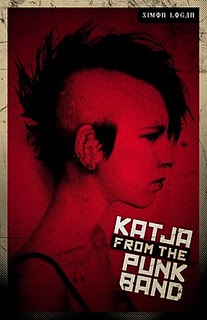
Katja From The Punk Band by Simon Logan

(published by ChiZine Publications, 2010, TPB, £varies, out now)

Playing like a Cold War thriller with piercings, Katja From The Punk Band is author Simon Logan’s second novel, following on from Pretty Little Things To Fill Up The Void. My first inclination was to think of this novel as Cyberpunk – but that would be misleading as there’s no ‘cyber’ to speak of. The author describes his work as Industrial or Fetishcore fiction. I like the term neo-noir. Set at an indeterminate time, on an Eastern Bloc-style ‘work’ island, this novel is tight, lean and populated by characters looking for a better deal. Katja, a charming punk-ette, is a waitress in a slum diner, who has come across an opportunity (a vial containing a valuable narcotic) to get off the island. All she needs to do is stay one step ahead of her pursuers, who  include her parole officer (Aleksakhina), her former boyfriend (Januscz), a low-life drug dealer (Kohl), and his boss (Dracyev). Along for the ride  is Nikolai, a wastrel junkie, hooked on drugs and arcade games, and slightly in awe of Katja, and her ever-present guitar (used more as a weapon than as a musical instrument). All Katja and Nikolai need to do is get the vial to the mysterious Man in Red, over on the mainland. Like all simple propositions, they never work out simply…

Logan’s prose is present tense, lending it an immediacy that feels fluid and not forced. The story hurtles along, a neat twist being that we get scenes from various character’s perspectives, often in the build up to an event of some kind. In lesser hands this style would feel manipulative and overly technical, but here it pulls the reader into the larger story at work; this is a grim world and all the characters are looking for their own bit of solace. There is a permanent gloom over the island; daylight has no place here. This could be the future or it could be the height of the Cold War. It doesn’t matter, as the style feels timeless, and effortless. The story plays out, in parts, like a classic thriller, chase sequence following and preceding action, often fast and brutal. At other times this feels like a tale of doomed hope (see the fated romance between Aleksakhina and Ylena); the author masterly spins bittersweet melancholy to counter the downbeat grind.

A neo-noir thriller unlike anything you’ll have read before. Find it, buy it.

Andy Jamieson, Editor

Visit Simon’s website: www.coldandalone.com

Simon’s next book is called Guerra and is out late 2012.

Sep 112011
 

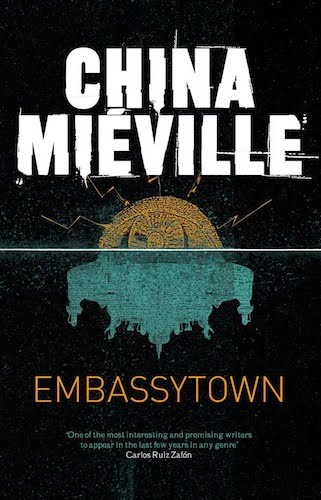
Embassytown by China Miéville

(MacMillan, 2011, HB, £17.99, out now)

A criticism often levelled at science-fiction novels is that they’re full of great ideas, but short on story-telling. It’s to China Miéville’s credit, then, that no matter how outlandish the worlds, cultures and artifacts he creates in his books, they always seem to occupy a meaningful place in his absorbing plots. Embassytown is no exception, and in fact can be seen as a masterclass in how to make a complex sci-fi invention absolutely central to the development and resolution of a story, rather than just decorating the backdrop to it.

Concepts like hyperspace travel and crises of alien diplomacy are old hat in the world of science-fiction, but to these familiar tropes Miéville adds a refreshingly original and cerebral take on xenolinguistics, or alien language. On the distant port planet of Arieka, human settlers maintain a peaceful co-existence with the enigmatic natives, truly bizarre alien creatures, the quirks of whose near-impenetrable and peculiar language mean that they are unable to lie. The human colonists can only communicate with their so-called “Hosts” through genetically-engineered ambassadors, whose enhancements enable them to mimick the exotic speech of the locals. The arrival of a new ambassador, unlike any who have gone before, heralds a breakdown in communication and an increasingly desperate situation for the humans now stranded on the very edge of known space.

Like much of Miéville’s work this book is rich with themes, some made obviously explicit and others less so. The use and abuse of language is of course central to the story, as well as its dangerous potential to mislead, confuse and intoxicate – both literally and metaphorically. The progress of linguistic breakdown in the book actually runs parallel with the gradual humanization of the main characters, many of whom begin the story as distant, unsympathethic creations but grow into fully-formed, relatable human beings by the conclusion of the book. This I believe is a deliberate ploy on the part of Miéville, who wishes to show us that traditional structures of language can be as much of a barrier between people as a tool for communication. If we look deeper, we can also discern a more general political theme running through Embassytown, that of the often destructive influence of colonising powers on the indigenous societies they disturb, and of the violent retribution that unchecked hubris can provoke.

One of Miéville’s greatest strengths as a writer is to keep such themes, potent though they are, from getting in the way of telling a good story. Though the book – much like its characters – initially seems to be holding you at arm’s length, it isn’t long before the varied strands of the tale begin to coalesce into a gripping narrative. The truly thrilling thing is to see how the author manages to build the plot itself around his invented theory of alien linguistics, its glorious complexity fuelling the varied developments of the main story. Just like The City & The City before it, Embassytown throws you in at the deep end and doesn’t hold your hand. As such, it may take the reader some time to grow accustomed to this strange new world, but it also completely transports you to a desolate planet on the edge of the known universe, as all of humanity’s carefully-constructed barriers begin to crumble, allowing loneliness and dread to creep in. This ability to perfectly balance the cerebral with the emotional is why China Miéville is one of the finest writers of fiction working today in any genre, and why we can expect many more groundbreaking works from him in the future.

Jim Taylor, Lead Bookseller, Waterstone’s Livingston

Sep 112011
 

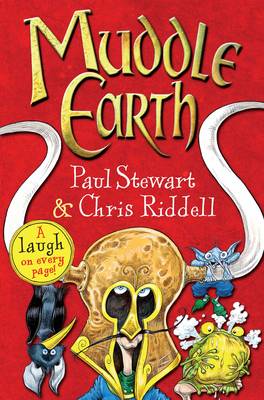
Muddle Earth by Paul Stewart & Chris Riddell

(MacMillan, 2011/2003, PB, £5.99, out now)

The creative team best known for their outstanding Edge Chronicles produced a more humourous fantasy title back in 2003, Muddle Earth, again aimed at younger readers. This paperback re-release  has a new cover in advance of the impending sequel, Muddle Earth Too, due out Autumn 2011. It seems cheap to describe Muddle Earth as a parody of Lord of the Rings – I like to think of it as more of a gentle homage.

Schoolboy Joe, plucked from our world by a summoning spell cast by Randalf (!) the wizard. Now, Randalf is not a particularly accomplished wizard by any means but unfortunately he is the only one that Muddle Earth has to rely on. He has summoned Joe (but not specifically so) in the hope that he will be the mighty hero that Muddle Earth needs in its time of need. This first book consists of three parts, three individual tales of Joe’s adventures as he: a) attempts to find out how to get home, and b) try to be the hero that he is expected to be…

The world of Muddle Earth is evocatively and humourously realised by writer Paul Stewart and brought to vivid life by artist Chris Riddell’s fantastic map and chapter illustrations. Stewart carefully balances humour and adventure across Muddle Earth’s three stories, in a way that Discworld fans will appreciate, although it is a more gentle mixture than Sir Terry’s yarns.

A fun, accomplished jaunt – but perhaps not quite up to the heights of Stewart and Riddell’s other fantasy works. However. I’ve read most of their work and I am a huge fan of their output, and this is most certainly worth a look for any fantasy lover.

Andy Jamieson, Editor