Jim Taylor

A ponderer with delusions of grandeur...

Feb 102013
 

So, it’s been officially confirmed.  After months of feverish speculation, J.J. Abrams has been named as the director of Disney’s new instalment in the Star Wars franchise, due for release in 2015.  When the possibility of Abrams’ appointment first came to light, myriad newspapers and webzines started spewing forth opinion pieces offering in-depth analyses of this artistic marriage, and what it might mean for the future of cinema’s most beloved film series.  Most of these articles seemed to hold a strongly positive outlook on Abrams’ appointment (the Guardian go so far as to call it a match made in “geek heaven”), with many focussing on his much-lauded rejuvenation of the Star Trek film franchise, the second instalment of which is due in cinemas later this year.  This Geekzine opinion piece will be one which takes a more measured view of Abrams’ appointment, and in part forms a response to articles such as Empire’s, which argue passionately that Abrams is the perfect choice to craft a film (or films) that will celebrate the legacy of Star Wars whilst standing as an impressive piece of work in its own right.  By contrast, this writer finds Abrams to be a disappointingly ‘vanilla’ choice for the director of Star Wars VII, and one whose track record – upon closer inspection – casts some doubt on his suitability to safeguard the legacy of the original trilogy.

Though his omnipresence in A-list circles may seem a relatively recent phenomenon, J.J. Abrams’ rise has been a gradual one, beginning with some Hollywood script work in the early ’90s followed by a fruitful television career, with shows Felicity and Alias (both of which Abrams created, wrote and directed himself) achieving considerable critical and commercial success.  He returned to the world of cinema in 2006, in the director’s chair of Mission Impossible 3, a film which managed to revitalise the ailing movie franchise.  Since then Abrams has directed twice more, bringing a rebooted Star Trek to the screen in 2009, and realising his Spielberg-homage Super 8 in 2011.  Star Trek Into Darkness, due to be released in May, will be the fourth movie he has directed in addition to his production work on films like Cloverfield and Mission Impossible: Ghost Protocol.  What all these films have in common (bar the unreleased Star Trek sequel) is that every one of them has been a huge success with critics and audiences alike, and Abrams has developed something of a reputation for being an artist who can turn a tidy profit without diluting his often geeky subject matter.  So far, so good; Disney’s appointment of Abrams as director of Star Wars VII seems a solid choice when taking into account his form of the last seven years.  But is he actually the right person for the job?

To properly assess Abrams’ merits as a potential Star Wars director, it is necessary to turn away from his more original work and instead look at his approach to the other two pre-existing franchises which he has successfully reinvigorated; Mission Impossible 3 & Star Trek.  Abrams’ original creations – such as Fringe and Alias – rightly have their own distinctive feel, and are of a consistently high quality, but it’s when we turn our attention to his work on others’ creations that we begin to see why Abrams and Star Wars might not be the perfect match.  Mission Impossible 3 is less of an issue here.  Despite being based upon a pre-existing TV series, the Mission Impossible film franchise had little in the way of mythology behind it; John Woo’s second instalment in 2000 had effectively turned the series into a mediocre Bond pastiche, and all Abrams had to do to preserve the Mission Impossible legacy was maintain a few vital elements (Ethan Hunt, the IMF, rubber masks) while he directed a much fresher take on the super-spy format.  Of much greater relevance here is Abrams’ Star Trek reboot, a new installment in a franchise with an extensive, pre-existing mythology across multiple media, stretching back decades.  Just like Star Wars.

So what can Abrams’ work on Star Trek tell us about his likely approach to Star Wars VII?  ‘Nothing definite’ is the short answer, but it might give us a few clues as to what we can expect, clues which are not at all encouraging.  While Star Trek is certainly an entertaining, exciting and well-shot blockbuster, it shows almost no reverence for the series’ classic mythology.  Abrams picks and chooses certain famous elements that long-time audiences will recognise (Starfleet, the Kobayashi Maru, green-skinned alien girls, Chekov’s preposterous accent)  but completely does away with the tone of the original movies and replaces it with the same knowing irony that permeates his other work.  In the context of original creations like Super 8, or a series with a slight mythos like Mission Impossible, this isn’t a problem; clearly, this is Abrams’ favoured approach to film making.  But in the context of a series with a long and influential history like the Star Trek franchise, such an approach reduced the new installment to simply a sci-fi action/adventure movie with a distinctly modern sensibility, merely wearing a skin of Star Trek mythology.  Scratch beneath the shiny surface detail, composed of gleaming, retro re-creations of control panels and ship hulls first dreamt of in the 1960s, and you’ll find very little indeed that ties Abrams’ Star Trek film to those that have gone before it.

And why not, you might say.  Star Trek was never perfect, and for every Wrath of Khan there was a Search for Spock.  Why not allow a much more irreverent re-interpretation of the adventures of Kirk, Spock et al for a modern audience, thereby revitalising the series as a whole?  What’s more, fans of Abrams’ film point to the plot’s emphasis on timeline differentiation as justification for the difference in tone; the temporal mechanics of the storyline ensure that this tonal inconsistency remains backed up by story logic.  But a similar approach by Abrams to the Star Wars universe will not work.  Star Wars VII will not be a reboot, but a continuation of the original trilogy.  It will need to show a reverence for what has gone before, and wholeheartedly embrace the mythology established by Episodes IV-VI.  Abrams may have reinvigorated Star Trek but he did not show it reverence, and this is why the success of his take on that titanic sci-fi series does not automatically mean – despite the beliefs of some film critics – that he is the right director for the Star Wars gig.

Another important consideration is that Star Wars – unlike Star Trek – has never been a hard sci-fi series.  Episodes IV-VI are as fantastical as they are futuristic, despite George Lucas’ misguided attempt to provide a scientific explanation for the Force in Episode I, and fantasy is far less resilient to the sort of smirking post-modernism exhibited by Abrams’ work than is science-fiction.  When you’re telling a story that is essentially an epic saga about space-wizards, you’re always swerving dangerously close to being ridiculous, something that many of Lucas’ early-80s imitators discovered the hard way.  Consider how extremely rare the moments of knowing humour are in Peter Jackson’s Lord of the Rings trilogy, for example, and how a general tone of irony, the like of which characterises Abrams’ Star Trek, would completely undermine a story which hinges upon more a profound suspension of disbelief by its audience.  The po-facedness required to make good fantasy films is resolutely out of fashion in Hollywood at the moment.  Indeed, Abrams is seen as a safe pair of hands precisely because what is considered ‘safe’ these days is a director who doesn’t take their subject matter too seriously, but for Episode VII to be a genuine continuation of the Star Wars saga it will have to take itself seriously.  For this reason, Abrams’ work on Star Trek is no guarantee whatsoever that he will direct a Star Wars film worthy of the name.

This article must come with a couple of caveats, however.  Just because Abrams has shown ironic and irreverent tendencies in his cinematic output up to this point, it doesn’t mean he won’t find an alternative way to approach Star Wars VII.  A very important distinction still needs to be made between the two great franchises of science-fiction cinema in this context, and that is Abrams’ attitude towards both of them.  By his own admission, he has never been a fan of the Star Trek TV series or accompanying movies, and this may go some way to explaining the dismissive attitude he has displayed towards the series’ history.  By contrast, he is by all accounts a huge fan of the original Star Wars trilogy, and this perhaps bodes well for a more reverent approach to that franchise’s mythology.  I have thus far underplayed the role of the screenwriter, too; Michael Arndt will arguably have even more of an impact on the direction of Star Wars VII than Abrams himself, and great things are expected from the scribe who brought us both Little Miss Sunshine and Toy Story 3.  There is still a very good chance that Episode VII will be a worthy addition to the Star Wars canon, and I for one hope it will prove every doubter wrong.  Certainly, whatever Abrams and Arndt produce is bound to be better than Lucas’ execrable prequels, but how much better remains to be seen.  Abrams perhaps has the potential to pull off a Star Wars film that celebrates the legacy of the series whilst simultaneously standing on its own merits as a quality piece of cinema, but such an outcome is by no means certain.

Jan 292013
 

Back in 1990, prolific writer/director Clive Barker’s Nightbreed was released in cinemas to little critical or commercial success.  Some blamed the bizarre tone of the movie; Barker, a noted horror writer, had created in Nightbreed – an adaptation of his novel Cabal – a fantastical romance, with the emphasis firmly on action and adventure rather than gore and terror.  What horror there is in the film is largely relegated to a slasher sub-plot that runs parallel to the film’s main story, that of a colony of sympathetic monsters who live beneath the necropolis of Midian, inexplicably located in the Canadian midwest.  Others (including Barker himself), placed at least some of the blame for the movie’s failure at the feet of the studio, Morgan Creek, whose decision to brutally re-edit Barker’s original cut and add a tacked-on twist ending resulted in a film that feels weirdly truncated and lacking in direction.  While it’s still possible to see the ghost of a great ensemble movie in Nightbreed, the theatrical version’s butchered edit, with its misplaced emphasis on the slasher storyline, relegates the eponymous Nightbreed to bit-players in their own film.

Despite its flaws, though, there’s still much to love about the movie.  The main storyline is intriguing (featuring as it does a group of horrifying monsters who are actually supposed to be the good guys), the make-up effects are terrific and there’s a nicely creepy turn from none other than cult director David Cronenberg, appearing in a rare acting role as the sinister Dr Decker.  These qualities have ensured that Nightbreed still has its devotees more than twenty years after its initial release, and their number has now grown to the point that they’re a cult following to be reckoned with.  Among them happens to be Russell Cherrington, a senior lecturer in film and video production at the University of Derby, whose recent efforts – along with those of Mark Miller, co-head of Clive Barker’s production company, Seraphim Films – have resulted in a version of Nightbreed which approaches Barker’s original, unedited vision finally seeing the light of day.

Early last year, Cherrington succeeded in assembling a new, extended cut of Nightbreed using footage which was excised from Barker’s original cut by Morgan Creek.  Much of this footage had been salvaged by Miller in 2009, when he discovered that it remained readily accessible but was of little value to the studio, who didn’t believe there to be a big enough audience to justify the commercial release of an extended version of Nightbreed.  Dubbed “The Cabal Cut” and running at 144 minutes, Cherrington’s new version of the movie is the closest edit yet compiled to Barker’s original director’s cut.  The efforts of Cherrington, Miller and various others have been supported by the so-called ‘Occupy Midian‘ movement, an online community committed to raising awareness of the work that has been done to bring Barker’s true vision of Nightbreed to the silver screen, or at the very least to secure an official DVD/Blu-Ray release.  A petition hosted on the movement’s website aims to demonstrate to Morgan Creek that there is a big enough audience to justify an official release of this extended version of the movie, and has thus far attracted over 12,000 signatures.

What the tipping point for such a campaign might be is uncertain, but in the meantime Cherrington has taken ‘The Cabal Cut’ of Nightbreed on the road, and in the last twelve months the movie has been shown at twelve film festivals in eleven different countries.  Whilst the campaign to secure an official release rumbles on, more and more screenings of the ‘The Cabal Cut’ are taking place, including several right here in the  UK.  Next month, the movie will be shown at the Keswick Film Festival in Cumbria, and after that who knows?  As word begins to spread, there is every chance that the larger international film festivals may begin to request screenings of the ‘The Cabal Cut’, and if those of us who wish to see Clive Barker’s Nightbreed restored to its former glory make our desires known to our local festivals and film societies, as well as signing Occupy Midian‘s petition, then Nightbreed: The Cabal Cut could soon be coming to a screen near you.

Jan 052013
 

With a cinematic release for the film adaptation of David Wong’s John Dies at the End just around the corner (January 25th in the US, March 22nd in the UK), now seems the perfect time to review This Book is Full of Spiders (TBIFOS), Wong’s sequel to that astonishingly good debut novel.  Like the first book, TBIFOS chronicles the adventures of hapless but not entirely hopeless best friends and amateur monster-hunters, John and Dave (along with Dave’s girlfriend Amy and her dog Molly), and Wong has once again concocted a potent mixture of horror, action and comedy which sees his slacker heroes take on zombies, shadow men, apocalyptic conspiracies and of course the eponymous giant spiders.  Unlike the first book, though, which featured a number of shorter stories, TBIFOS consists of a single tale, epic in scope, concerning the invasion and subsequent contamination of John and Dave’s home town by a swarm of inter-dimensional spider monsters that turn people into shape-shifting zombies.

If that last sentence sounds strange to you, then you’re evidently not yet familiar enough with the scary, exciting and just downright weird world of John and Dave, a world well-captured in the book’s trailer, which those of an arachnophobic disposition should probably avoid watching:

A lazy way of describing Wong’s writing would be to say that it’s like Douglas Adams meets H.P. Lovecraft, yet I can’t think of a more accurate comparison.  There are moments of surreal humour counterbalanced by genuinely awful horror, and TBIFOS, just like its predecessor, is a book that scares as much as it amuses.  If anything, this sequel is darker still than John Dies at the End; the sense of fun which characterised the first book is somewhat tempered here by a much bleaker worldview which has also been evident in some of Wong’s recent articles for Cracked.com.  At times, the author seems at pains to emphasise the brutal fact that, no matter how hard you try or how just your cause, people are still going to die and there’s nothing you can do about it.  Whenever John, Dave, Amy and Molly do gain the upper hand, it seems as much a result of dumb luck as any effort on their part, and often appears to be little more than a temporary victory in their endless struggle against the encroaching darkness.

Over the course of the book, every main character is put through the metaphorical wringer, and the effects of this harrowing ordeal are actually most noticeable in the character of John.  In the first book, John had the manner of a B-movie action hero, able to face any adversary or situation – no matter how ludicrous and horrifying – with a corny quip and a headlong charge.  He was the perfect opponent for inter-dimensional demonspawn, a spiritual successor to Ash Williams and Jack Burton, whose own inherent ridiculousness made him the perfect fit for a world suddenly turned ridiculous.  While the character retains these qualities in TBIFOS, Wong also chooses to humanise John in a way that dilutes them.  For the first time, John’s bravado and seemingly inexhaustible supply of one-liners begin to look like bluster designed to conceal his own fear and helplessness.  In this way he seems to represent the book as a whole, the character’s emotional turmoil being used by Wong to convey the idea that monster-hunting is all fun and games until someone’s possessed by a hideous spider parasite and forced to murder their family and friends in front of you.

Despite this darkness of tone, however, This Book is Full of Spiders is far from an unrelenting gloomfest.  The action unfolds at the sort of thrilling pace that will keep you gripped until the wee small hours, and Wong’s talent for weird humour ensures that there are dozens of laugh-out-loud moments throughout the book, sometimes when you least expect them.  Just as with his previous novel, the author also has fun with the concept of the unreliable narrator; the books are written in first-person perspective by a character called David Wong, ostensibly as a journal of actual occurrences, and there are several moments throughout the narrative (and one telling exchange in the epilogue) where the reader is forced to question how much of what they’re reading actually transpires within the confines of the story, confirming that Wong still has a mischievous streak.  Above all, the writing here shows evidence of an author maturing without losing the sense of wild adventure that made him such a joy to read the first time around, and despite its often dark subject matter, This Book is Full of Spiders is a hugely fun read.  Easily one of my books of last year.

Jan 052013
 

Safety Not Guaranteed – the debut feature from director Colin Trevorrow – is ostensibly a film about time travel, but is really a film about love and regret.  Its science-fictional trappings, although taken seriously as being central to the movie’s plot, thus serve as more of a sideshow to the human relationships which lie at the centre of the film.

Morose magazine intern Darius (Aubrey Plaza) finds herself on a road-trip to the seaside town of Ocean View with her boss Jeff (Jake Johnson) and painfully shy fellow intern Arnau (Karan Soni) to investigate a newspaper advert offering the opportunity to go back in time.  They assume that the advert’s author, a grocery store employee named Kenneth (Mark Duplass), is either a prankster or a madman, but when Darius poses as a volunteer time-traveller in order to get closer to the story, she begins to see a kindred spirit in Kenneth, whose anger and paranoia mask a deep-seated passion and intelligence.  Over the course of their stay in Ocean View, Darius begins to suspect that Kenneth, despite his eccentricities, might actually have been able to build a time machine, but more importantly that he is someone she might be able to connect to despite her own loneliness.

Safety Not Guaranteed has all the stylings of the so-called ‘mumblecore’ movement of indie films, featuring as it does eccentric characters, verbose dialogue, social awkwardness and irony by the truckload.  But it’s also a film with real heart; a romantic comedy that does justice to the term by being both warm and funny, with great performances from Plaza and Duplass in the main roles, and an impressively tragicomic turn from Johnson as a man who attempts his own version of time travel by trying to recapture the simpler pleasures of a lost youth.  Duplass’ Kenneth remains an enigma right up until the film’s final scenes, and even then the extent to which his genius might be madness is not completely clear.  But this doesn’t make the blossoming relationship between himself and Plaza’s Darius any less touching, or the film’s final shot any less poignant.

Regret and the overwhelming desire to fix one’s past mistakes are what motivate the characters in Safety Not Guaranteed to revisit their respective pasts, whether literally or figuratively.  The film’s emphasis on these aspects of human frailty mean that the time travel element is pushed to one side, but its sci-fi credentials are in evidence nonetheless.  Through its use of implication and suggestion, the film remains just open enough to interpretation to let the viewer decide whether Kenneth’s time machine works or not, and whether the incongruence between characters’ own versions of their pasts and the apparent truth is a product of their own deception, or of the world having imperceptibly changed around them.

At times, Safety Not Guaranteed seems comparable to time-travel movies like Rian Johnson’s Looper or Tony Scott’s Deja Vu, where what the viewer sees throughout the film is actually a number of different time-lines intersecting, with time itself depicted as fluid and ever-changing.  But to ruminate too much on the temporal mechanics of the story would be to rob it of its key strength and focus, namely an affecting portrayal of love and regret.  That is why Safety Not Guaranteed is a great romantic comedy, but it can still be a sci-fi film if you want it to be.

Dec 192012
 

Can Martin McDonagh’s follow-up to ‘In Bruges’ reach the same artistic heights as its much-lauded predecessor?

In the meta-fictional spirit of Seven Psychopaths, I’ll begin this review by talking about this review.  I found that once I began writing this piece, what had initially been intended as a straightforward film review quickly turned into a deeper analysis of the movie, one which couldn’t be conducted without going into spoilery detail about some of the film’s key scenes.  This was not pretension on my part, but merely something that occurred naturally as I tried to write about the film.  As such, in a way that coincidentally mirrors the bisected nature of Seven Psychopaths itself, this will be a review of two parts; part one a conventional film review, part two a more in-depth analysis of the film’s themes.  And with this being a Martin McDonagh film, there’s depth aplenty.  You have been warned.

PART ONE (to be read before – or after – viewing the film):

Back in 2008, Martin McDonagh (a writer/director with an extensive background in theatre) surprised a lot of movie-goers with his brilliant black comedy In Bruges.  Those who had seen McDonagh’s Oscar-winning short Six Shooter might have been expecting the jarring combination of violence, humour and pathos that characterises his work, but many who went in cold would have been mislead by the new film’s marketing campaign, which had been at great pains to portray In Bruges as little more than a buddy-comedy with an exotic setting.  Strangely, and despite In Bruges‘ becoming a cult hit in the interim, the same fate seems to have befallen McDonagh’s new film Seven Psychopaths, with posters and trailers for the film placing the emphasis firmly on the screwball comedy elements of the movie.  This isn’t to say that Seven Psychopaths isn’t funny, because it definitely is, but just like its Belgian-set predecessor there’s a profound darkness to the film that counteracts these moments of light-heartedness, a darkness at which the film’s marketing has only hinted.

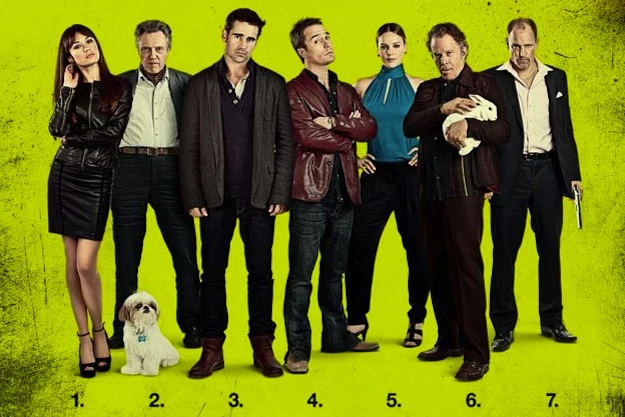
In short, Seven Psychopaths is a movie about itself.  McDonagh’s metafictional conceit becomes apparent early on in the film, as Colin Farrell’s burnt-out screenwriter Marty (an excellent foil for the film’s crazier characters) labours away on a script for an action movie called – you guessed it – ‘Seven Psychopaths’, with precious little success.  Keen to help is Marty’s eccentric actor friend Billy (Sam Rockwell, the undisputed highlight), who also moonlights as a dog-napper with his partner Hans (Christopher Walken, better than he’s been in years).  When Billy kidnaps the favourite pet of mob boss Charlie Costello (a menacing Woody Harrelson), the three men are plunged into a world of brutal violence, and all of a sudden Marty finds himself with plenty of material for his screenplay, whether he wants it or not.

Although a very funny film, due mainly to the great chemistry and dialogue between the three leads, Seven Psychopaths also features a couple of unexpected twists and some truly shocking moments which keep the audience from becoming too comfortable.  Like In Bruges, it walks a fine line between tragedy and comedy, and often manages to encompass both at the same time.  Without ramming it down the audience’s throat, McDonagh has created a crime film which also serves as a critique of crime films.  His eschewal of the conventional three-act structure climaxing in a blaze of glory is signposted in one of the ‘meta’ conversations between Marty and Billy, where the writer expresses his desire to create a film which sets itself up as the ultimate revenge flick, before simply ending with the main characters heading out into the desert and talking out their problems.  McDonagh, though, is too much of a sucker for a big shoot-out to let the film end in so subdued a fashion, but it is the way in which he handles the onscreen violence in Seven Psychopaths which is arguably the most interesting thing about the film.

Make no mistake, Seven Psychopaths is very funny, but it is also very violent.  So much so that its receipt of a 15 certificate from the BBFC at times seems surprisingly lenient.  The film has a high body count, and doesn’t skimp on the gore, with several scenes of execution, mutilation and immolation shot in an unflinching style.  It becomes clear throughout the course of the film, though, that McDonagh is not interested in glorifying violence, but rather in emphasising the true horror of it.  The casual brutality displayed by some characters is made all the more shocking when McDonagh, through Marty, forces the audience to dwell on the traumatic consequences of their actions, and question whether such individuals should ever be glamorised or thought of as heroic.  In a neat subversion of movie conventions, the true moments of heroism in Seven Psychopaths come through characters’ rejection of violence in the face of danger, rather than their embracing it and thus blurring the line between heroes and villains.  Rarely has a pacifist viewpoint been so eloquently put across in mainstream cinema, and the film’s biggest strength is this rebuke to film-makers who would follow the outmoded conventions of the medium by having their heroes pursue a path of violence as if there were no other option.

Seven Psychopaths is, however, more obviously flawed than the near-perfect In Bruges, and there are a couple of issues which do manage to detract from the film’s abundant qualities.  McDonagh’s unconventional approach to narrative structure, while interesting, leads to pacing issues in the first half of the film.  There are several plot points that feel as though they needed more time to fully develop, and a number of sequences where McDonagh could perhaps have been more ruthless with his editing.  Also, the film’s treatment of its female characters is clumsily handed.  Although meta-fictional reference is made by Hans, upon reading Marty’s script, to the fact that his women characters are underwritten and generally suffer horrible fates, this mea culpa from McDonagh feels like a rather lazy attempt at subversion.  Why not utilise the same approach he adopts to tackle egregious movie violence when critiquing Hollywood’s dearth of decent female characterisation, by including in the film a genuinely strong female character, rather than simply copying the targets of his satire and then flagging it up for all to see?  As it is, Abbie Cornish, Olga Kurylenko and Linda Bright Clay have little more than cameo appearances in what is an utterly male-dominated film.

These gripes aside, Seven Psychopaths is undoubtedly another triumph for McDonagh and Farrell.  It works as a comedy, a tragedy, a crime thriller and a meditation on violence.  It also works as a subversive piece of meta-fiction, which satirises the conventions of Hollywood storytelling in a self-referential manner that manages to avoid pretentiousness.  The audience’s realisation that the movie they’re watching is the script that Farrell’s character struggles to finish is a gradual one, and it gives the film an intriguing dimension that will reward repeated viewings.  Having said all that, the film would not succeed nearly so well were it not for Sam Rockwell.  His nuanced portrayal of the unpredictable Billy – at once pathetic, lovable and a little scary – is the stand-out among a plethora of great performances in Seven Psychopaths, and Rockwell can feel legitimately cheated if he doesn’t receive an Oscar nomination come January.


PART TWO (to be read AFTER viewing the film):

Coming soon….

Dec 172012
 

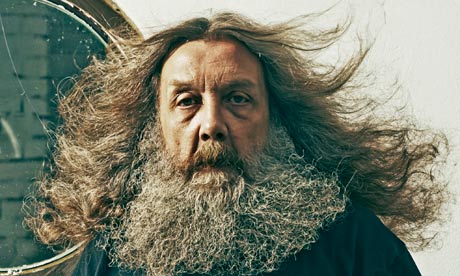
Alan Moore is better known as the visionary writer of such comic book classics as Watchmen and V for Vendetta, but he’s recently turned his hand to scripting short films in collaboration with director Mitch Jenkins, the latest of which – Jimmy’s End – is now available to view online.  Given Moore’s much-publicised disgust with Hollywood’s adaptations of his work, it’s perhaps not surprising that he should decide to start creating movies of his own, albeit on a much smaller scale.  Jimmy’s End was filmed entirely in Moore’s home town of Northampton and cost just £11,000 to make, a sum which Moore recently suggested would only cover the coffee budget on the set of a comic book blockbuster.

Despite its small budget, though, Jimmy’s End shines with class.  The work of director David Lynch is a clear influence throughout the film’s half-hour running time, as its dark and surreal story unfolds at a creeping pace, beautifully photographed by Jenkins.  Down-and-out James (Darrell D’Silva) , lost after a heavy night on the town, stumbles into the St. James End working men’s club, and encounters a bizarre array of frightening and mysterious characters who may be lost souls like himself, or something much more ancient and terrible.  The film is rich with symbolism, and the imagery employed by Moore and Jenkins lends an almost palpable atmosphere to proceedings, as James confronts the awful reality of St. James End.  Moore himself has an unsettling cameo in the film, and strong performances all round ensure that the extreme weirdness of Jimmy’s End never dilutes its underlying menace.  This is a film that deserves to find a wider audience, and hopefully there’ll be more of the same from Moore and Jenkins in the near future.

Jimmy’s End is available to view online for free, and the official website can be found here.