Andy Jamieson

Sometime Geek Overlord, bi-monthly Dungeon Master, part-time care worker, reigning Husband of the Year, & full-time daddy. Also, proficient proverbial juggler.

Aug 242011
 

Biomega by Tsutomu Nihei (Viz Media, £8.99 – volumes 1 to 6 are currently available)

Injecting a much needed zest of fresh awesomeness into the manga marketplace comes this visionary title, Biomega. It’s set in the future after a devastating virus, called N5S, has swept across the Earth, turning most of the population into vicious zombie-mutants. So far, so standard, you may think. But it’s Nihei’s art and story that grip.

Zoichi Kanoe is our hero, an agent of TOA Heavy Industry (looking to cure the viral plague), zooming around on his Akira-esque bike. Like all cool anti-heroes, Zoichi is not quite all he appears to be…

The first volume sees Zoichi head to the island city of 9JO in the middle of the Pacific Ocean, to track down Eon Green, a young girl who may be crucial to TOA’s efforts against the spreading virus. But Zoichi isn’t the only one looking for her…

Volume One is quite straightforward and lean in its plotting, but as we get further in, things start to get a tad surreal. I’m up to the fourth book and it is starting to get a bit out there, to the point where I’ve had to re-read the last couple of volumes to see if I’ve missed any crucial plot points. I don’t think I have; Biomega is just plain daft in parts.

I can’t deny it though – Tsutomu Nihei has created a modern masterpiece with Biomega. His art is stunning and dynamic (easily the best manga art I think I have quite possibly ever seen) but it’s his bleak vision of a future bereft of hope that seals the deal.

Andy Jamieson, Editor

Aug 242011
 

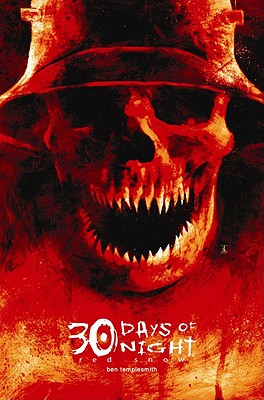
30 Days Of Night: Red Snow by Ben Templesmith (published by IDW, £13.50 approx, out now)

Back in 2002, before all this Twilight/vamp-goth-rom malarkey nibbled its way into the mainstream, writer Steve Niles and artist Ben Templesmith came up with 30 Days Of Night, a neat spin on the vampire genre, set in the small outpost settlement of Barrow, in Alaska, where for 30 days – you guessed it – the place is plunged into darkness. Flash-forward eight years and numerous spin-offs/sequels later, the concept isn’t quite so fresh. Vampires, and horror in general, have penetrated the mainstream market and aren’t the niche attraction they once were; we have tv series, book series, film series… The whole genre has arguably got tired and predictable.

Then in 2007, like a blast of fresh air, the 30 Days Of Night stable delivered quite possibly the best in the series so far, and certainly the most original: Red Snow, written and illustrated by Ben Templesmith, on solo creative duties for the first time on the title that launched his career. Set on the Eastern Front in WW2, Nazi raiding parties are terrorising the small pockets of civilisation dotted around the frosty landscape. Enter British military attaché Corporal Charlie Keating, assisting the Soviet war effort against the viciousness of the Nazi raids. Things get perilous when Keating soon realises there are worse things than the SS out in the cold… Yup, there’re vampires prowling the darkness and they aren’t fussy whether it’s Soviet or Nazi blood they gorge on! This volume collects the 3 issue mini-series and it’s a cracker; Templesmith has produced an excellent tale, skilfully plotted and brilliantly scripted, fully exploiting the claustrophobia of the setting to its maximum potential. His art, as usual, is atmospheric and hauntingly evocative. He even has time to cram in a couple of sneaky cameos from the first 30 Days Of Night…

So, a great WW2 story and a brilliant standalone vamp yarn (it’s by no means essential that you’ve read the rest of the 30 Days titles), plus a reinvigoration of a flagging series. A must-read.


TEMPLESMITH FACTS:

– Born on March 7th 1978 in Perth, Western Australia.

– Made his American comics debut with Hellspawn in 2002, a spin-off from Spawn.

– He is left-handed.


RECOMMENDED TEMPLESMITH:

Fell – Volume 1: Feral City (Image Comics, £10.99) collects the initial run of this currently ongoing series; written by Warren Ellis (you’ll have heard of him, right?), this is a supernatural detective thriller which is mean, moody and spooky. Wormwood – Volume 1: Gentleman Corpse (IDW, £14.99) is Templesmith’s creator-owned comedic-horror title and has run since 2004, on-and-off. Collected in three volumes so far (2: it Only Hurts When I Pee & 3: Calimari Rising, both available at £14.99, published by IDW), this fuses sick laughs with gruesome horror.


Andy Jamieson, Editor


Aug 232011
 

Terry Practhett portrait by Darren McNaney, freelance illustrator, animator & digital effects artist.


Geekzine Editor Andy Jamieson interviewed Sir Terry Pratchett by phone in September 2010, on the eve of the promotional tour for ‘I Shall Wear Midnight’:

This has to go down as probably one of the happiest, most nerve-wracking moments of my life, interviewing one of my literary heroes. I remember setting up for the interview, as the clock ticked down to the time when I was expecting a phone call from Sir Terry’s agent, making sure my baby daughter was fed & watered and not likely to throw a wobbly or fill her nappy. With her happily entertained, I could at least focus on the job in hand. And it went better than I could have expected. I was originally instructed by email that I would have a limited time talking to Sir Terry so I deliberately structured my questions: a set that I thought it essential to ask, pertaining to his latest book, then I drafted a set of questions that, if there were time, it would be great to ask, and then I came up with a third set consisting of proper geeky-fanboy questions that I would be flippin’ lucky to get to ask. I got to ask all three sets of questions and the interview couldn’t have gone better. Below is the first part of the interview, as featured in issue 7 of the Edinburgh Geekzine, released earlier this year. Enjoy.

Andy

ps -I’d like to thank Clare Hall-Craggs at Doubleday for making it happen.


Andy Jamieson: I Shall Wear Midnight is the fourth book to feature Tiffany Aching. What is it you like about her as a character?

Terry Pratchett: Because I could make her grow, most importantly. It’s very beguiling to have a character and never ever change them but Tiffany starts off as a little girl who doesn’t know very much and ends up, more or less, as a woman, and a tough one as well, who has to do an awful lot of difficult and dangerous things. 

AJ: Tiffany undergoes her own kind of Salem-esque witchhunt in your new book.

TP: You could certainly say that was one of the sources.

AJ: Was it an enjoyable challenge turning the inhabitants of the Chalk against Tiffany?

TP: It’s a little comment about how the way people feel can be changed in bad ways, for example, about how rumours can spread and, even if the rumours are untrue, nevertheless, we know that there is no smoke without fire. And so the whole nastiness wretches up, until someone throws a stone at an old woman because she has no teeth and mutters. As a metaphor that kind of thing can happen very easily today.

AJ: Onto the Nac Mac Feegles, who I see as unofficial Discworld ambassadors for the Jacobite-era Highlands…

TP: Ha! I suppose so. For the first Tiffany book, The Wee Free Men, we started the signing tour in Scotland, on the basis that if I survived that it would be a successful tour! In fact everywhere we went in Scotland people seemed to like the Nac Mac Feegle, and we were greeted with pipes and such like. Anyone who reads the Tiffany books knows that the Nac Mac Feegle are kind of a gentle parody of Scotland. Take, for example, Billy Connolly and Rab C. Nesbitt. Whilst people laugh because their performances are extravagant parodies, they are based on the kernel facts. Back to the Feegle, as the Tiffany series moves on, they become, shall we say, more real.

AJ: The clan structure, for example, is intriguing.

TP: Right, yeah. Well, I can’t give too much away in the book, but when the Nac Mac Feegle want to get serious, they can get very  serious indeed.

AJ: Moving into the main Discworld series, the next two scheduled books are Snuff (featuring Sam Vimes) and Raising Taxes (the third Moist von Lipwig book). How far along are these books and what can fans expect?

TP: Raising Taxes is one that is hanging in the air. Snuff, which isn’t quite as scary as it sounds – it’s about the Tobacco industry – is about finished.

AJ: Snuff sees the return of lovable cop, Sam Vimes.

TP: Yes, and he’s by himself for the most part in this one. He’s a copper out of his jurisdiction, which always makes for fun!

AJ: Are there any more plans for Discworld graphic novels and is it a medium that you like?

TP: Well, Neil Gaiman famously started out in graphic novels, and he said that the trouble with the medium is that they’re not exactly a book and they’re not exactly a film. They have certain drawbacks. I don’t think there is anything planned in regards to future Disworld graphic novels. Quite frankly, it’s a struggle to get all the humour in. There isn’t room for all the fine detail that works in the Discworld novels. For example, it’s the occasional small sentence here and there, or a particular line at the end of gag, or whatever it is, that gladly does the job, and you can’t redo that in a graphic novel.

AJ: Also out is the dvd/blu-ray of Going Postal, the third of Sky’s Discworld adaptations (after Hogfather and Colour Of Magic). Are there any further adaptations in the works?

TP: There is another one being planned. If I say that it involves football that might give you a clue which one it is, although I couldn’t possibly say exactly what it is called…

AJ: Out of all your books, are there any in particular that you would like to see filmed, or not filmed?

TP: I really enjoyed writing Monstrous Regiment, because I had a lot of fun doing the research, and it’s one of the books that wrote itself very easily. Because it’s about something quite accessible like the Peninsula War, I think it‘s accessible to people who don’t normally read fantasy. In the same way, for example, that Unseen Academicals, though it has wizards and so forth in it, is about football. And not just about how football is played but how it relates to the community and so on. Social history, almost. I like doing that kind of stuff. And I loved doing the Dwarf fashion show, which is a first I think!

AJ: The Carpet People is still my favourite of all your books. Have you at any time considered doing a sequel to it?

TP: I did once, a long time ago. But I think the answer is: so many books, so little time. And it was good as it was. Things that I would have put in the sequel have eventually appeared in the Discworld in other guises. In terms of getting things done, I was surprised at one point, whilst writing Snuff, that I was producing two thousand words a day, which is quite fast. I’ve not been writing that quickly for a long time.

AJ: Have you and Neil Gaiman ever talked about working together again?

TP: Well, we kind of did. You see, when we finished Good Omens we were all hot for doing a sequel, or so we thought. And both of us were working on things that could go into this sequel, and then I think one day one of us said “You know, I’m not certain we have to do a sequel,” and it turned out that neither of us really wanted to do a sequel but we both thought that the other guy did so we let it play along. I think the world is better served with us both doing our separate thing than the two of us doing a joint thing. Also, it’s down to schedules. Back in those days Neil Gaiman was hardly the Neil Gaiman of today and I was barely Terry Pratchett, and nobody cared, if you see what I mean. And now both of us live in a world where we are in constant demand for a number of reasons and just finding the time to do a collaboration properly would be difficult…

To be continued…


Andy Jamieson, Editor 

The concluding part of this interview will be featured in issue 8 of the Edinburgh Geekzine, and on this website, on or around November 2011.

To read Andy’s review of I Shall Wear Midnight, click here.



Aug 232011
 

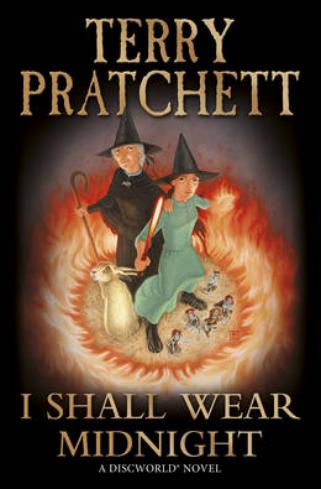
I Shall Wear Midnight by Terry Pratchett

(Doubleday, PB, £6.99, out now)

Tiffany Aching’s fourth outing presents the intrepid young witch with her most sinister challenge yet; to see off the malicious spirit of a long-dead witch hunter, simply known as the Cunning Man. He ghosts through the populace of Tiffany’s homeland of the Chalk, turning all against her. The ever-loyal Nac Mac Feegles, along with a few familiar faces (Mistress Weatherwax & co.), aid Tiffany in rising to the challenge of the Cunning Man. No one blends fantasy adventure with humour the way that TP does. And yet again, he delivers. Sir Terry has carved a mature tale of paranoia yet laced with enough of his requisite expected wit to stop things ever getting too serious. Tiffany Aching is fast becoming a most memorable heroine. Another great Discworld read.

Andy Jamieson, Editor


Aug 232011
 

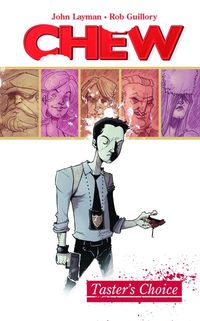
Chew by John Layman & Rob Guillory

Available so far: Volume 1: Taster’s Choice (RRP £7.50), Volume 2: International Flavour and Volume 3: Just Desserts (both RRP £9.99), published by Image Comics.

Chew is an American comic book penned by John Layman and illustrated by Rob Guillory; it centres around one Tony Chu. Tony is cibopathic. For those of you who don’t know, that means he can take a bite out of something, and he knows all about it. For instance, he takes a bite out of a piece of food and he knows where it’s come from and how it’s been cooked. Now you could leave it there, or you could take it a step further. And this is the beauty of Chew; it does go a step further. Tony Chu doesn’t just chow down on food.  Tony Chu nibbles on corpses too. It’s this special ability that gets him hired with the FDA (Food and Drug Administration) who have FBI like powers in an America where all chicken is outlawed, due a to a mad bout of bird flu that wiped out millions of Americans. That’s when the real fun starts. Tony’s first assignment is to discover the murderer of a health inspector and it all spirals wildly from there.

I really don’t wanna give too much away here ‘cause one of my favourite things about this comic is the twists and turns; they feed into the plot seamlessly and instead of leaving you dying for more caused they’ve stitched you up with some irritating money-grubbing cliffhanger, you genuinely want more because you wanna know what the hell they’re gonna come up with next.

Its originality is the main thing that drew me to this comic whilst trawling the net for something new and shiny. Chew pulsates with personality. It’s dark, sick and a little bit twisted.

Before you even get as far as reading the thing you’ll get drawn in by the visuals. You’re looking at a comic made up of soft, rich pastel colours, which lure you into a false sense of security. Only to jog you back to reality with one of Tony’s cibopathic induced flashes, or just the generally odd content. What you get throughout is that great juxtaposition of the beautiful and the disconcerting, or just downright disgusting. This contrast persists and makes the comic richer for it, even the babes aren’t really babes. Wait till you meet the Russian chicks; you’ll see what I mean. Their body proportions are all wrong, it’s like the creators are purposefully trying to make sure you’re just a little on outside of your comfort zone, all the time.

This is comic for those with a sense of humour, albeit a little bit of a weird one. It’s for those of you who want to read something different. Chew isn’t a neat little package, though it is slick. Your good guy doesn’t just swoop in, get the girl and beat the bad guys, it’s messier…

Much messier.

This mess is what makes Chew such a compelling read, the unpredictability and creativity are what make every panel pop and make you want to re-read the books to make sure you haven’t missed anything interesting. More importantly they make this into a series you want follow – it feels like a series made by geeks for geeks. It reminds me of ‘Spaced’; there’s that same feeling that the creators know what they like, so they’ve decided to run with it, and they’ve got a feeling you’ll like it too. I’ve recommended this for the last year to anyone who’ll listen and I’m gonna continue to do so: give it a chance, and you’ll soon be doing the same. Quite frankly, it’s awesome.

So far the comics have been compiled into three books, Volume 1: Tasters Choice, Volume 2: International Flavour and Volume 3: Just Desserts, with a fourth volume due out late 2011. And honestly?

I can’t wait.

Kate West, Bookseller, Waterstone’s Edinburgh George Street 


Aug 232011
 

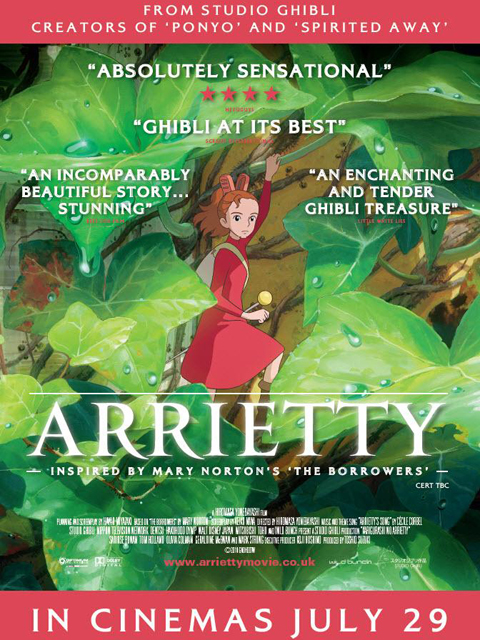
Arrietty (U)

Released in the UK on 29th july 2011. Running time: 94 mins approx.

Directed by Hiromasa Yonebayashi, screenplay written by Hayao Miyazaki & Keiko Niwa, based upon The Borrowers by Mary Norton

Voice cast: Saoirse Ronan, Mark Strong, Olivia Colman, Tom Holland, Geraldine McEwan & Phyllida Law

The latest offering from Studio Ghibli (all together now; pronounced Jib-lee) is a return to form after the hit-and-miss of Ponyo. Adapted from the Mary Norton’s children’s classic, The Borrowers, the self-titular Arrietty (voiced by Saoirse Ronan) lives with her parents, Pod (voiced by Mark Strong) and Homily (Olivia Colman) Clock, in a house in the countryside. And this would be quite normal were it not for the fact that they are all tiny wee folk, standing a few inches tall; they are the Borrowers. They eke out a contented existence in the human world, ‘borrowing’ small items from their erstwhile landlords, always just enough to suffice their needs, and never more. But this comfortable life is threatened when a sickly young boy, Sho (voiced by Tom Holland) arrives at the house to stay with his grandmother, Sadako (Phyllida Law), and her meddlesome housekeeper, Haru (Geraldine McEwan).

At the start of the film, Arrietty is just celebrating her 14th birthday – she has come of age and is about to embark on her first ‘borrow’ with her robust and resilient father, Pod. It’s whilst on this first expedition that we really get a feel for the life of a borrower; the animators have captured the wonder of the human world as seen from the perspective of someone who is only a few inches high. A sugar cube is that rarest of luxuries and it is the acquisition of one for Arrietty’s mother, Homily, that ultimately puts the entire family Clock in jeopardy. Arrietty is seen by the young boy, Sho. Over the course of the first half of the film, they strike up an unlikely friendship, a bittersweet relationship that carries through to the film’s climax. The appearance of another borrower, the feral Spiller, who saves Arrietty’s father, Pod, raises the question amongst the Clock family – where are all the other borrowers? Spiller does not know, and earlier on Pod and Homily refer to neighbours who used to live in the same human house, who moved on. It is one later exchange between Sho and Arrietty that the sick boy delivers a despairing verdict on the future of the borrowers: they are destined to die out. It’s the bleakest point of the film and ultimately defines the story. When the end comes, it is sad but hopeful. It is hard not to feel that Sho is perhaps right.

Studio Ghibli, and the debut director at the film’s helm (although a veteran key animator at SG), have produced a superb adventure film, suitable for all the family. I think that this is perhaps the studio’s strongest film since Spirited Away. It is a beautiful spectacle and a good, timely reminder of the power of 2D animation in these CGI/3D dominated days. the detail of the human’s house and of the Clock family’s secret domain is intricately captured; water trickles in mammoth globules, and rodents haven’t looked this sinister since Nimh. The countryside surrounding the house is lush and vibrant – no one recreates the beauty of the natural world and its splendour quite like the craftsmen at Studio Ghibli.

The dubbed voice cast is eclectic and strong throughout (and curiously varies between the US and UK versions; Will Arnett, for example, voices Pod in the US version). Saoirse Ronan’s Arrietty is, thankfully, the standout performer; so much of the film relies on the emotion carried in her voice, and Ronan delivers near faultless character work.

In conclusion: A wonderful adventure movie that should appeal to all. This is a return to form for Studio Ghibli, who seem to have found their next directing star in Hiromasa Yonebayashi who, on this form, is a worthy, long-term successor to Hayao Miyazaki’s legacy.

Andy Jamieson, Editor