Jim Taylor

A ponderer with delusions of grandeur...

Jul 172013
 

Jonny rediscovers a classic horror manga from the ’70s, and finds it a mixed bag despite its towering reputation….

The Drifting Classroom, by Kazuo Umezu, was first serialised between 1972 and 1974 in Japan’s Weekly Shonen Sunday magazine – “Shonen” essentially translating as “for boys”.  It instantly set the benchmark for Manga horror, and has been hugely influential to authors throughout the genre.

The set-up for the story is minimal: a primary school in Japan mysteriously disappears during an earthquake, leaving behind an empty crater and taking with it the pupils and school faculty.  The series predominantly follows the character Sho as he and the rest of the school try to survive in the mysterious wasteland that now surrounds their school, whether defending themselves physically, or simply trying to remain sane.  As the oldest pupils, the 6th year class takes it upon themselves to protect the younger students, and try to figure out how to return to their home.  Sho soon finds himself appointed their leader, but not without accusations that he was somehow responsible for what happened to them.

The series definitely favours style over substance, though with Umezu’s distinctive artwork perfectly capturing the atrocities of the wastes, that’s no bad thing.  Many of his creatures can clearly be seen to have directly influenced Junji Ito’s creations for example, with notable similarities between the two artists.

But although Umezu’s creatures are fantastic, the story’s countless barbaric scenes of children fighting one another with homemade weapons – not unlike Lord Of The Flies and Battle Royale – are where the illustrations struggle.  Frequently the similarity between the kids is so great that it becomes difficult to distinguish one from another, and at least two of the major characters are virtually identical.  This never really disrupts the story greatly, and the nightmarish monsters steal the show anyway, but it certainly doesn’t help alleviate some of the weaker sections.

Drifting Classroom’s story lacks direction and many of its plot arcs end abruptly, often leaving ideas hanging, never to be revisited.  Throughout the 11 volumes there are countless false starts, and only in the latter half does a real narrative begin to develop.  This could be a result of their collected format rather than the original, weekly instalments, but short of reading one chapter a week, I would advise viewing the series as an anthology of ideas, rather than one ongoing story.

Reading each vignette alone also helps to distract from some of the plot holes, which are few, but glaring.  A prime example is the children’s need for drinking water being solved by the school’s swimming pool.  Much of the integrity of the story holds up in simple terms; needing water and finding it in the swimming pool makes perfect sense, until you reason that the water must be chlorinated and presumably not fit for drinking.  Perhaps this is a reflection of the childlike innocence that the school pupils are bringing to the otherwise brutal wasteland that surrounds them, reminding the reader that despite everything that happens to them, they are still no older than thirteen.  Perhaps not.

The Drifting Classroom is an enjoyable series, and without it, the Manga horror genre would undoubtedly be different.  It has numerous flaws, and at times doesn’t read especially well, but even given that, its illustrations and numerous ideas make it a worthwhile read.

Jonny West

Jul 132013
 

As it approached the end of its most recent season, HBO’s Game of Thrones began to attract more vociferous criticism for its lack of non-white actors.  The series’ main characters are overwhelmingly presented as pale-skinned, a casting choice which has often led to accusations of orientalism, and one which has also characterised (to varying degrees) other genre fare in recent years, such as the resurrected Doctor Who and Peter Jackson’s Lord of the Rings films.  A number of arguments have been advanced to defend such monochromatic casting, not all of which are without merit, but all of which are ultimately based on flawed assumptions about the supposed limits of representation in onscreen fiction.  In this piece, I shall argue that it is foolhardy to strive for verisimilitude in productions of fictional works set in other times and on other worlds, and in doing so demonstrate that producers’ misguided attempts at “realism” should not limit the demographic of actors cast in shows such as Game of Thrones.

Every main character from the first three seasons of Game of Thrones has been white, with the sole exception of Khal Drogo (played by Jason Momoa, who is of Native Hawaiian descent).  Why should this be?  The argument usually made is that, as the world of George R.R. Martin’s A Song of Ice and Fire books (upon which the series is based) is modelled on medieval Eurasia, this is a time of very little intercontinental migration, and that as most of the story’s action takes place in a land which is an analogue of northwest Europe, the vast majority of characters would be racially homogeneous (assuming a process of evolution similar to our own).  A similar argument is often made to justify the all-white casting in the Lord of the Rings film trilogy, and while it is not completely without merit (the harsh realities of long-distance travel in such a time would indeed render instances of intercontinental migration rare), it should not completely preclude the appearance of non-white faces among the cast.  After all, just because a fantastical land is based upon medieval Europe, that doesn’t mean it is medieval Europe, and assumptions about evolutionary biology and historical immigration patterns need not automatically apply.  But such a response meets the ‘historical accuracy’ argument head-on, rather than recognising that the real problem with the argument is the assumption about fictional representation upon which it rests.  In other words, it doesn’t take account of the fact that what we see when we watch Game of Thrones or Lord of the Rings is a representation of a story, not an historical document.  It is not what is really happening in the world of the story.

Rather than arguing about historical precedent, evolutionary biology or intercontinental migration, we should focus on the fact that what we’re seeing is a representation of a story that is happening in a place which is entirely other, even if this place exists only in the mind of the author (and subsequently their readers/viewers).  Striving for verisimilitude – that is, semblance to reality – for the sake of preserving an audience’s suspension of disbelief is often a necessary endeavour, but it can also unnecessarily constrain producers and casting directors in their selection of actors.  This is a problem which most frequently plagues productions of an historical or fantastical nature, as these are the ones whose content is most removed from contemporary reality.

Let me explain using the example of language and dialogue.  Tom Cruise attracted criticism for retaining his natural American accent when he played a German army officer in the 2008 (English-language) film Valkyrie.  Critics who felt this impaired the film’s verisimilitude seem to have assumed that if Cruise had spoken his English dialogue with a German accent the film would have somehow been a more ‘authentic’ portrayal of the setting and characters.  This is obviously nonsense; in real life, German characters (in Germany) would be speaking the German language to each other, and having English-speaking actors adopt a false German accent is no more authentic than having them simply speak the English dialogue with their native accents.  Of course, what is really happening is that in the world of the film, the characters are in fact speaking German to each other, but it is represented to us – the audience – in a language we can understand.  This is the key distinction; on the one hand we have the actual world of the story, and on the other we have the way in which that world and the events within it are represented to us in an intelligible fashion.

Valkyrie works well as an example of this distinction, because it is set in a specific time and place that actually existed, and so more easily allows us to understand that when he hear characters speak English in the film, they are actually – within the world of the story – speaking German.  But consider how this distinction applies to imaginary worlds like those of Lord of the Rings or Game of Thrones.  When Gandalf address Frodo in the films (and the books), or when Tyrion speaks to Bronn in the TV series (and the books), the dialogue is rendered (by the script and the actors) in English, or alternatively in any number of contemporary languages by dubbing/subtitles.  But does the language spoken by the characters within the world of the story actually sound like English?  Probably not.  Certainly, Tolkien and Martin may have it otherwise, but it would stretch credulity to breaking point to suggest that a language identical to modern English coincidentally existed on fantastical worlds completely removed from our own (even if, as was Tolkien’s conceit, the events of The Lord of the Rings actually take place in Earth’s distant past).  These books and films could go down the route of inventing completely original languages for the characters to speak, just as the actors in Valkyrie could have spoken in German instead of English.  Two of Mel Gibson’s films, The Passion of the Christ and Apocalypto, strove for linguistic verisimilitude through the use of Aramaic and Mayan dialogue respectively, but there are numerous commercial and creative reasons for authors and film-makers to forego such an arduous endeavour in the context of fantasy fiction.  It is far simpler therefore to represent the language(s) of the story-world in a way more readily accessible to contemporary, monoglot audiences.  Crucially, this model of representation also extends to characteristics other than language, and has major implications for the supposed limitations on casting actors for any fantastical film or TV series.

This brings us to the issue of an actor’s skin colour, and how essential it might be to their portrayal of a character.  Simply put, unless the colour of a character’s skin is to have some significance to the plot, it needn’t have any bearing on considerations of casting when an actor is selected to play the part.  In this situation, it is simply the best actor who should be chosen, irrespective of ethnicity.  Those who advance the cause of verisimilitude will insist that having non-white actors play characters who are, say, native to north European climates will hinder the audience’s suspension of disbelief, to which I would say two things.  Firstly, if a viewer has suspended their disbelief for dragons and magic, it seems hard to believe that they could not do so for what appears – for all intents and purposes – to be a dark-skinned character living in medieval Scandinavia.  Secondly, and far more importantly, we must remember the distinction between the story-world (which we cannot truly see) and its representation (which we do see).  It has already been established that the likelihood of characters in these films, books and TV shows actually speaking the language in which they are presented is slim, and the same can go for these characters’ appearance, too.  Unless part of the story’s plot hinges upon a character’s specific ethnicity, this characteristic has no special significance, and thus an actor of any racial background can be selected to play them.  They are, after all, only ever playing a representation of the character, whose true skin colour in the world of the story might not even be a colour which is recognisable to we of the mundane, real world.

There will always be issues of supply and demand in TV and film casting, and it might be that an apparently colourblind approach could still lead to an overwhelmingly white cast in a series like Game of Thrones anyway.  Whether this would be due to the inherent prejudices of casting directors or an actual lack of depth in the talent pool of ethnic minority actors would be up for debate (and would ask questions about deeper problems within the industry), but what is certain is that concerns over a fantasy series’ verisimilitude need not impose racial limitations on producers and casting directors when they audition actors for such a project.  They are, after all, only creating a representation of a fictional time and place, for the true world of the story will always remain beyond their reach.

Jul 112013
 

Jonny looks back on the British horror film which became an instant classic of the genre….

An all-to-common theme running through the horror genre is to have pretty girls and hunky guys get their kits off and show just enough flesh to maintain a 15 certificate, before they’re horribly butchered by a bad guy, in a gruesome visual clash of pleasure and pain.  This tried-and-tested system can be repeated as many times as the director sees fit throughout a film, to chalk up enough mediocre thrills to get a DVD release, and go straight to the sale section a month later.

This could so easily have been the case for Neil Marshall’s The Descent, given its premise of an all-girl group of friends finding themselves lost together in an unexplored cave network.  All girls?  Lost and scared?  Well surely that’s more than enough of an excuse for lifelong friends to curl up together to stay warm, perhaps choosing that exact moment to explore unspoken urges they’ve always felt and maybe finding their clothes miraculously falling off due to rips sustained in the caves, revealing lingerie that everyone knows is the sensible choice for outdoor pursuits.

But this low-budget, British horror film released in the summer of 2005 lived up to none of these expectations….and I couldn’t be happier.  Instead of cheap thrills, The Descent offered its audience genuinely scary, psychological horror which played on acute claustrophobia and isolation.

A group of old friends have gathered together for an adventure weekend like they had when they were young, as an excuse to catch up with each other and to embrace the attitude that you’re only as old as you feel.  After a short time in the depths of a cave a shift in the rocks closes the path behind them, and cuts off their supply bag, containing much of their equipment.  Fortunately they’re quick to reason that the caves they’d chosen to explore had multiple entrances, so this mishap shouldn’t have any disastrous outcome, they simply need to press on to their exit.  All is well until their self-appointed leader confesses that they are in fact in a previously unexplored network of tunnels, leaving them guessing as to whether there’s an exit anywhere, or if anyone else even knows they’re down there at all.

Claustrophobia kicks in with extended shots of the girls crawling through narrow tunnels, akin to The Shawshank Redemption or Aliens, offering the viewer no room to breath.  This is where the panic really takes hold, as the team are isolated deep underground, with the possibility of no exit, and no rescue.  Their only source of light in the caves comes from fluorescent glow sticks, which brilliantly offer ample opportunity for flickering shadows and fleeting glimpses of things that go bump in the night.

So compelling is their struggle through the tunnels, that when they begin to suspect something else is in the caves with them and discover they are being hunted, it all comes as a bit of an unnecessary change of pace.  The slow-burning horror of being trapped in the dark, in a worryingly plausible situation is so effective, that the introduction of blood-thirsty beasties breaks the tension, as the audience can breathe a sigh of relief and be reminded that it’s all OK, because monsters don’t exist.  Not to mention that the biggest flaw in the film is with the creatures themselves, who despite being “evolved perfectly to survive in the dark,” can’t seem to find a group of women so long as they all stand still and hold their breath.

Forgiving this minor oversight, the latter half of the film quickly finds its feet, and runs as fast as it can through the darkness.  The violence and ‘hunt-or-be-hunted’ attitude adopted by some of the survivors makes the first half look positively serene, as the body count quickly racks up.

The Descent is a slick and clever psychological horror that doesn’t rely on cheap tricks to entertain.  It’s a brilliant blend of atmospheric tension, relatable terror and a selection of genuinely jump-inducing scares.

Jonny West

Jul 082013
 

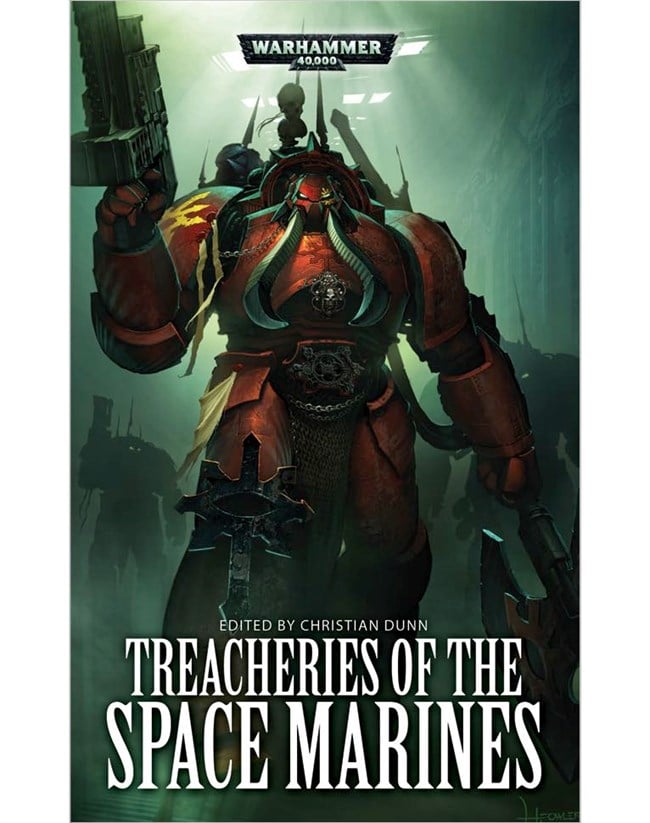
Griff delves into a war-torn anthology of heresy and betrayal from the vaults of the Black Library….

There is an old saying that the Devil gets all the best songs. In the Grim Darkness of the 41st millennium, it is almost comforting to know that little will have changed: Chaos has some damned excellent stories, as Treacheries of the Space Marines so excellently demonstrates.

Naturally, one would expect Chaos Space Marines to be the subject of brilliant, gripping tales. With all the strength and genius of their loyalist brethren, but enhanced with a Machiavellian streak a mile wide and a spectrum of psychoses unique in the Warhammer 40,000 universe, they make for excellent subject matter.  And the authors featured in Treacheries do not disappoint: schemes, insanity and bloodshed abound in every story, all lavishly wrapped in the nightmarish imagery of the daemonic and Immaterium.  The imagination at work is equal parts impressive and singularly disturbing, with musical plagues and twisted Slaaneshi torture practices lingering long and wonderfully hideous in my memory.

What really amazed me with Treacheries was the depths the stories explored.  Bloodthirsty readers won’t be dissatisfied, for battles certainly abound and the action is that which can only be provided by Space Marines: visceral in the extreme.  But around these flares of ultra-violence, and even sometimes amidst them, the authors are not afraid to dig into their characters and the situations in which they find themselves.  The power-plays between such mighty, fickle warriors, the unique ethos of each individual Traitor Legion, the very psychologies of these monstrous figures that haunt the Imperium’s nightmares.  It all serves to add rich streaks of detail that transform Chaos from simplistic, one-note ‘Insert-Your-Battlecry-Here’ maniacs into intricate, twisted and often utterly fascinating characters.

If there’s one gripe I have with Treacheries, it’s that very few of the stories have any great tension in them.  The only sense of any characters in actual jeopardy came from the ordinary, Imperial characters going up against these fallen angels of death; said angels themselves, as is probably fitting for the setting, sail through the action not quite effortlessly, but certainly without the will-they-won’t-they question of survival hanging over their heads.  The redeeming irony of this problem is that, very often, the real tension and threat is off the battlefield, often posed more by characters’ ‘allies’ than their enemies.  Whatever tension certain stories lack in terms of survival is more than made up for in terms of trust; as a reader, I found myself constantly questioning who could be trusted, how far they could be trusted, and if a dagger in the back was coming what form would it take.  All in all, from an anthology with Treacheries as the operative word, perfectly satisfying and enjoyable as a narrative experience.

I would be remiss if I didn’t mention Jonathan Green’s short story Liberator as the head-and-shoulders champion of this anthology.  That is not to devalue any of the other entries (indeed, the consistently high quality only enhances Liberator‘s success), but this is hands-down the bravest and most successfully executed depiction of a heretic’s genesis since the Eisenhorn Trilogy, with an ending so wonderfully ambiguous that it proves ‘grimdark’ does not have to be a negative term.

The danger of any anthology is that it will be of mixed, inconsistent quality.  There will be peaks of excellence and uninteresting troughs that, thanks to an anthology’s modular nature, can be hopped over.  Treacheries does not fall foul of this danger; even if I had not been reading it in my capacity as scrutiniser of all things geek, it would have been a cover-to-cover experience without question.  No story steps on another’s toes, each offers its own hook and angle on Chaos Space Marines, and it has left with me with the best final impression possible – that I want to experience more tales featuring the Imperium’s Arch-Betrayers.

On the Black Library website, treacheries of the Space Marines‘ page boasts that it features ‘some of Black Library’s finest authors’.  Not an empty boast, I can assure you.

Griff Williams

Jul 042013
 

Jonny revisits a cult horror film starring Zach Galligan and David Warner, and discovers whether it’s actually any good….

The back of the DVD case describes Waxwork as “The Rocky Picture Show-meets-House of Wax” and in some ways it’s right (there is a house of wax central to the plot), but in many more it’s altogether wrong (there’s none of the charm, campness or self-knowing of Rocky Horror).

The film has its feet firmly planted in the archetypal standards of the horror genre, introducing a group of teens whose ranks meet the requirements of jerk, jock, bimbo and loveable-though-annoying-protagonist.  The kids quickly find themselves invited to a midnight preview at a waxwork museum which has shown up in a residential district, and don their best suits and dresses to attend.  Following form, the jerk character (distinguishable by his constant smoking, and flicking of cigarette butts) is the first of many to meet a grizzly fate within the museum: bitten by a werewolf after a half-hearted off-screen transformation into what can only be described as a malicious Papillon.

The antagonist and the “attractive-enough-to-be-important-but-ugly-enough-to-not-be-killed” girl escape, but they find no help from the police, who refuse to believe their reports that several of their friends have been killed in the waxworks.  After seeking aid elsewhere the pair discover the nefarious scheme in progress involves bringing back from the dead, eighteen (because 18=6+6+6 which is, sort of, the number of the beast) of the most evil people from history, by creating voodoo, wax effigies using human sacrifices, disguised within the exhibits. A quick look through the characters in the waxworks, as shown throughout the film, reveals these eighteen evil characters to include: a vampire, a werewolf, a mummy, a zombie, the Phantom of the Opera, Frankenstein’s Monster, an alien, a freak show snake-boy, Jack The Ripper, the invisible man (or perhaps just a nasty man with a bandaged face), an evil monster baby, Audrey 2, a man with an axe and the Marquis De Sade (who appears to be modelled after a sexy pirate-gypsy.)

Despite having the absurd plot and characters required, Waxwork falls distinctly short of the horror-satire it so longs to be.  Comparing it to House of Wax and The Rocky Horror Picture Show is fair insofar as it falls somewhere between the two.  It has a small number of very graphically violent scenes, mostly focusing on the squashing of heads, and also has a few lighthearted sequences – a German professor teaching a history lesson about the Nazis (comedy gold) – but as such it doesn’t fit alongside either film snugly.  A musical number or two, in keeping with Rocky Horror, would help tip the scale toward the ridiculous and would perhaps balance the violence in the film by forming a sweet and sour appeal.

Waxwork isn’t funny, scary or simply bad enough to be a great film, and a much better evening could be had with a pair of fishnets and a water pistol, or hiding behind your fingers in a dark room.

Jonny West

Jul 022013
 

Ryan casts a critical eye over a reissue of the sci-fi legend’s earlier work.

The Bloodline Feud isn’t a ‘new’ new book from the unstoppable Mr. Stross, but I’d be a bit surprised if you’ve read it before.  It was previously published in the UK as two separate books with fairly forgettable covers and titles (sorry, Charlie, but the last thing The Family Trade and The Hidden Family sound like is good sci-fi), and due to some publisher-based strife the Merchant Princes series died of starvation three books in, only surviving in the US.  Well, long story short, he’s a bit more popular these days, and the series is back on track in the original 600-page installments.  There are two more volumes which have just been released, The Trader’s War and The Revolution Trade, bringing us half-way in this near-Robert Jordan-length epic.

So what have we been missing?  As usual with Stross, genres and tropes are happily stood on their heads.  The core of the plot is that it’s possible for a single bloodline of people to move between two alternate Earth timelines.  The protagonist, a well-written, nicely developed female character, is the long-lost orphan of this family, who is brought back into the fold like a dog being thrown into a room full of angry bobcats.  This is a book of assassinations and politics written in blood, with betrayals and twists by the armful.  The characters are all well-written and motivated, with character progression being one of Stross’ main strengths in this series.  There’s a maturity (cutting both ways) to the majority of their motivations and actions, and while the temptation to turn this into a sprawling, character-heavy jargon-filled tangle must have been strong, there is not a single under-used voice.  The action and fast narrative keep the underlying economics-based plot bouyed up, and while descriptions of eighteenth-century business start-ups and discussions of universe-jumping revenue streams might not be your usual thing, Stross moves it along at such a pace, throwing in so much intrigue and unexpected humour, that you’ll be hooked long before the end.

Flaws are few and far between, one of the most notable being the point when the reader is dragged out of the story by the unedited catch-up text from what would have been the start of book two, but if you’re looking for something genuinely different that’s long-form and not excessively demanding then the Merchant Princes series will be worth picking up.  One warning: if George R.R. Martin’s writing schedule is doing bad things to your blood pressure, just know that Stross is taking a few years off to write other things before he starts on the second half of the series, so you might want to read these three slowly….

Ryan Thomason