Jim Taylor

A ponderer with delusions of grandeur...

Jul 012013
 

There’s an urban myth in the writing business: if a book devotes more space on the cover to the author’s name than anything else, then it is trying to sell that book on the strength of the author. Stephen King novels remain the perennial example of this. Books where the author’s name is less obtrusive tend to be sold on the strength of the concept and premise – or, at least, the cover art.

This myth might translate at least partially to promotional material for films. For instance, the effluvial The Great Gatsby could not stop touting its director, Baz Luhrmann, which should really tell you all you need to know about it. But what about promotional material that doesn’t just keep the director’s name small, but utterly conceals it?

After Earth is M. Night Shyamalan’s return to the director’s chair after wandering in the wilderness for three years as penance for The Last Airbender. I’ll confess to being legitimately surprised when, during my pre-emptive research for this film, his name cropped up like some sort of guilty confession. Never since the counter-intelligence operations surrounding D-Day has so much effort been put into concealing something from so many people.

And the real irony? All that effort is wholly wasted. Having M. Night Shyamalan as its director does not help or hinder After Earth in the slightest.

It fails wholly on its own demerits.

Similar to its post-apocalyptic competitor, Oblivion, After Earth commences with an expository rush. A thousand years ago, mankind was forced to flee Earth because of our foolish, foolish environment-destroying ways (oh when will we learn, and when will Hollywood find a better catalyst for our journey to the stars?). However, the colonisation effort of their new world, Nova Prime, is hampered by a war with the Ursa: a vicious species of alien living-weapons that sense purely by scenting human fear. Will Smith plays Cypher Raige (yes: Cypher. Raige.), a soldier who discovered how to suppress his fear and become a ‘ghost’ to the Ursa, allowing him to kill them with abandon and save all mankind.

And people wonder where rumours about Will Smith’s ego come from.

Anyway, that’s just the backstory to the film. Which is good, because After Earth‘s central plot is actually pretty sparse. After triumphing over the Ursa, Cypher attempts to patch up his relationship with his son – soured by years in the military and the death of Cypher’s daughter at the hands of the Ursa – by taking him on a routine spaceflight that just so happens to be transporting a captive Ursa.

Did I mention Cypher’s also two days from retirement?

Naturally, the spaceship crashes on a now-inhospitable Earth, Cypher is grievously wounded and it’s up to his son to live up to his father’s legacy and save them by recovering a MacGuffinous emergency beacon conveniently located a film’s-length away from the crash site.

What’s tragic is that this set-up has some potential. It’s never going to be a landmark in the sci-fi genre, but the journey into adulthood of a guilt-ridden, overshadowed child being mentored by his stern, emotionally crippled father has the makings of an entertaining character piece. One perhaps entertaining enough to overlook the typical bad-science and plot holes that really should have been filled by common sense (why does the future-tech have the appearance and structural integrity of nature furniture, or how come no one has realised that a predator that hunts by fear pheromones can be thwarted with greater ease by a hermetic suit than hack philosophy?).

But the problem is, in order to have a strong character piece, you need strong character actors. I Am Legend demonstrated this perfectly: Will Smith was capable of carrying a relatively simple story on the strength of his acting. Taking a typical action hero and injecting him with a likability, or at least an emotional connection, has been the bread and butter of his career. And yet, with Cypher, it seems that when he learned to repress his fear it came at the price of repressing every other damned emotion in the psychological spectrum. It’s difficult to blame him, in a sense: playing any character who keeps his feelings buried beneath a deep layer of military procedure and detachment is walking a fine line from just playing a bland, unemotional mannequin. There are moments where there is the faintest glimmer of depth in his acting, but for the greater part of the film Smith sadly seems to be putting more effort into a growly, grizzled accent than a simmering emotional cauldron.

His son, Jaden Smith, playing Cypher’s son, Kitai, is placed in the unenviable position of carrying the film. After his performances in The Karate Kid and The Pursuit of Happyness, I was almost convinced that he might actually have the chops to balance the film’s action hijinks with the vulnerability and development his character required. However, like father like son, Jaden is nowhere near the par he has set for himself and, since Kitai is by far and away the primary focus of the film, his inability to deliver is blown up to monolithic proportions: inescapably spread out from beginning to end while his father’s equally disappointing performance is mercifully (for him) sidelined. Most of his lines come out as mumbled slurries of maybe-words delivered atonally by what someone (now might be the time to fashionably heap some blame on M. Night Shyamalan) clearly thought was a scarred, awkward kid with some daddy issues seated deeply alongside a major guilt complex.

The entirety of the blame doesn’t lie with Smith Jr., however. The poor lad is, for the most part, clearly trying his best, but the movie seems insistent upon straitjacketing him. For a film supposedly centred around the shifting dynamics of a fractured father/son relationship, the plot and pacing offer this core concept little opportunity to develop. It’s damned hard to have any sort of meaningful interaction between the two characters when one is shouting instructions as the other is being chased by monkeys/birds/frost (yes, we’re back to The Day After Tomorrow‘s wizard notion of having frost be a pursuant threat). The film’s need to overload its story with artificial and wholly unconvincing jeopardy – over the past thousand years, Earth’s fauna has become entirely man-eating, its climate has random temperature drops, and the atmosphere is nearly unbreathable – squeezes out almost any opportunity for Cypher and Kitai to actually confront what should be the real tension in the film: their relationship. What’s really unfortunate is that in the one scene where they do get a breather between the birds and monkeys to do so, the film almost becomes engaging, and maybe even a little moving.

Acting aside, After Earth provides passable visuals and special effects: Earth post-humanity is pleasantly lush, if lacking the impact of its Oblivion counterpart, and the starship crash scene manages to ramp up the heartbeat admirably. Also of merit is a complete absence of the Shyamalan Twist, although this is offset by the quite idiotic message that Cypher espouses. Turns out, conquering fear is not achieved by confronting your issues and concerns head-on and either finding a solution for them or coming to terms with them, but completely ignoring everything but the present moment. The film terms this practice ‘ghosting’, but this existential act of jamming your head in the sand seems more like Ostriching to me.

It seems that every reviewer has made some comment about the unspoken, underlying purpose of this film. Some have joked that After Earth is the most expensive fifteenth birthday present in human history, while others have murmured about the possible Scientology undertones. I find myself sitting in the moderates’ camp: After Earth is clearly a vehicle for young Jaden Smith, where his father symbolically retreats from the central heroic role and educates the next generation on the supposed craft of blockbuster badassery. I’d question whether this film is a complete creature of nepotism – I really do think Jaden had the credentials to justify his casting, especially given his last on-screen interaction with Smith Sr. – but the hidden meaning isn’t so very hidden.

It seems a shame then that Jaden Smith is bearing the brunt of the flak (rightly) being directed at After Earth. He’s bad in it, certainly, but he’s one element in a mixture that ranges from equally bad to slightly mediocre at best. It’s unfair to single Jaden out for special criticism, and its also incredibly dangerous.

If we don’t watch ourselves, M. Night Shyamalan might get away from this film unscathed and make something else.

Griff Williams
Jun 302013
 

And so we bid a fond farewell to this year’s Edinburgh International Film Festival.  A typically diverse programme of movies from around the world brought us touching drama, thrilling action, surreal fantasy and insightful documentaries, and made for a fascinating fortnight of cinema.  The festival always concludes with a “Best of the Fest” line-up shown on the last day, and almost inevitably this selection of twelve films (apparently chosen through audience reaction) misses out some of the lesser-known gems that have screened over the last two weeks.  As such, Geekzine’s festival coverage will conclude with our alternative “Best of the Fest” rundown, giving honourable mentions to the movies we feel deserve recognition for their sheer quality, as well as announcing our favourite film of this year’s festival.  Some of these films we’ve already reviewed, some we haven’t, but rest assured that all of them are thoroughly deserving of your attention….should they ever receive a UK release!

The Berlin File

Two very different spy thrillers impressed early on at the festival.  Satirical black comedy The Colour of the Chameleon, from Bulgarian director Emil Christov, tells the story of a deranged former KGB agent who embarks on an elaborate mission of petty vengeance, just as Communism begins to fall in Bulgaria.  Walking a thin line between comedy and tragedy, the film skewers the hypocrisy of political radicals as well as offering a sobering condemnation of state surveillance practices in former Communist countries.  The Berlin File (which also appears in the festival’s official “Best of the Fest” line-up) is a Korean espionage thriller of a very different hue, taking its cues from more action-packed spy films like the James Bond and Jason Bourne franchises.  Its stunning shoot-outs and fight scenes don’t make up for an overly-convoluted plot which doesn’t quite hold up to scrutiny, but it’s genuinely fascinating to see a film whose protagonists are North Korean, a perspective which is rarely represented in big-budget cinema (though not without good reason).

Before Snowfall

Beguiling Iranian sci-fi Taboor was the first film we saw at the festival, and its meditative tale of an elderly exterminator travelling through what might be a post-apocalyptic Tehran is bleak but enchanting.  Of a similar atmosphere was Norwegian director Hisham Zaman’s debut feature film Before Snowfall, a tragic road movie about a Kurdish farm boy pursuing his runaway sister from Iraq to Norway in order to commit an honour killing.  As the setting changes from the slums of Istanbul to the snowscapes of Oslo, via Greek forests and German subways, the film also explores the immigrant experience in modern Europe, following the young antihero as he makes new friends and enemies on his journey towards a devastating conclusion.

Lukas the Strange

There are often a number of films at the festival which deal in dreamlike surrealism, and three in particular this year strove to blur the line between fantasy and reality in such a way.  Lilou’s Adventure, from Japan, and Lukas the Strange, from the Philippines, both featured child protagonists embarking on journeys into the unknown to find missing loved ones. Whilst Lukas sees the eponymous young hero encounter strange and magical happenings right from the beginning – before abandoning his family, Lukas’ father reveals that he is actually a mythical half-horse creature called a tikbalang – Lilou‘s eponymous heroine only encounters the fantastical once she begins searching for her lost friend Kokoro, and through a series of Lynchian dream sequences finds her way to an alternate version of Tokyo.  While both films have compelling ideas and strong individual scenes, they could have benefited from some judicious editing, and both are so oblique in their storytelling as to be ultimately rather unsatisfying.  A much more concise and coherent piece of mundane magic is presented by Emperor Visits the Hell, a Chinese film which retells a classic fairytale about gods, demons and the underworld without any costumes or special effects.  Despite its humdrum appearance, the story and performances draw you into the tale of a desperate emperor trying to escape the bonds of hell, and it ends up being a thoroughly satisfying little film.

Old Stock

Not all the films at this year’s festival were po-faced meditations on reality and morality, though.  Pixar’s Monsters University proved itself to be almost as loveable and entertaining as its predecessor, 2001’s Monsters Inc, although not quite up to the the studio’s astronomically high standards.  Also turning heads was Tudor Giurgiu’s Of Snails and Men, a Romanian comedy-drama set in 1992 about a group of factory workers who try to save their jobs by selling sperm.  It’s rather lazily been billed as the Romanian Full Monty, but the comparison is an apt one; the unfolding drama of the main characters’ home lives is juxtaposed nicely with the amusingly ludicrous plan they concoct to protect their livelihoods.  The Canadian film Old Stock is also a comedy with a serious side, telling as it does the story of a young man living in a retirement home to hide from his troubled past.  At times it’s a little too quirky for its own good, but the film’s combination of gentle humour and tragicomic romance make it one of the highlights of this year’s festival.

Motorway

Even an arty affair like the Edinburgh International Film Festival is not devoid of the odd action film, and there were two this year which stood head and shoulders above their peers.  Motorway stars veteran Hong Kong actor Anthony Wong, and follows two traffic cops in their efforts to bring down an infamous getaway driver.  Unique in its focus on the driving action in particular, the film almost feels like a police-centric version of The Fast and the Furious, and despite coughing up almost every cop cliche in the book proves to be a thrilling watch.  A rather different, but no less enthralling spectacle is Frankenstein’s Army, from Dutch director Richard Raaphorst.  An inspired work of crossover horror, its array of utterly stunning monster designs more than makes up for any shortcomings in the film’s script and structure, and in terms of sheer enjoyment it was one of the very best films to be found at the festival.

We Steal Secrets

As is the case every year, EIFF 2013 also showcased dozens of quality documentaries over the last two weeks.  Unfortunately, we at the Geekzine were only able to catch a couple of them, but both proved to be superb examples of the form.  We Steal Secrets: The Story of Wikileaks is the new film from director Alex Gibney (Taxi to the Dark Side, Enron: the Smartest Guys in the Room), in which he attempts to present an objective account of the rise of the Wikileaks organisation, and its acquisition and dissemination of thousands of classified documents pertaining to the wars in Iraq and Afghanistan.  By demonstrating how far-reaching issues of security and possible evidence of war crimes became obscured by the media’s obsession with the people behind the leaks, Gibney makes a powerful statement about the strength of personality and the insidious power of vengeful governments.  The other documentary we caught was Khaled Jarrar’s Infiltrators, a gripping chronicle of the many attempts made every single day by Palestinians to illegally cross over the wall into Israel.  Some succeed, some fail, but the viewer is made to feel like they’re with all of them every step of the way.  We Steal Secrets is due to be released in the UK on 12th July, and although Infiltrators doesn’t yet have such a date, both of these informative and engrossing films are well worth your time and money.

And so we come to the ultimate accolade; the Geekzine film of the fest!  Those of you who have been keeping up with our reviews over the last two weeks may have noticed that one movie is conspicuously absent from the above list, and that movie is Shane Carruth’s magnificent Upstream Color.

Upstream Color

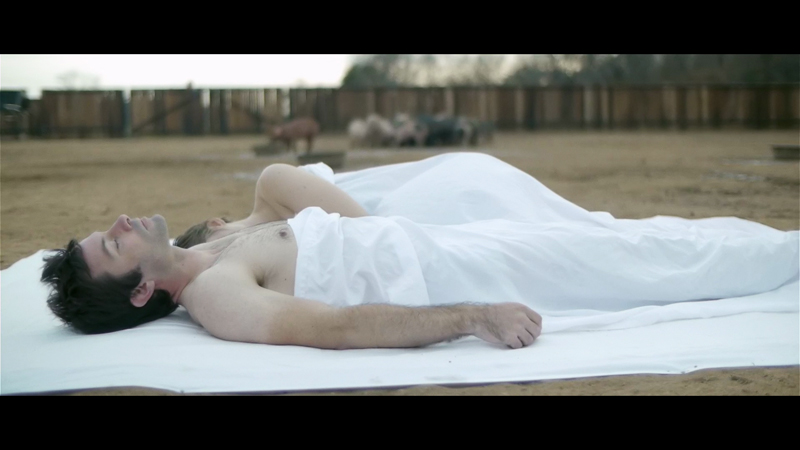
Upstream Color actually manages to combine in one movie many of the core elements of the festival’s best films.  It’s perplexing, philosophical and fantastical, while at the same time being tragic, romantic and profoundly moving.  Many critics feared that Carruth’s follow-up to his 2004 cult hit Primer would be unable to live up to the standard set by that film, but even though it’s taken nine years to realise, Upstream Color is more than a match for its predecessor.  Its embarrassment of cinematic riches, including stunning cinematography, wonderful performances from its two leads and a magnificently haunting soundtrack, mean that it’s an easy choice for Geekzine’s film of the Edinburgh International Film Festival 2013!

So that’s it for this year.  Thanks for reading all our reports and reviews over the last two weeks, and as always we welcome your comments on which films have taken your fancy at the 2013 festival.  Be seeing you!

Jun 282013
 

Nazis make the best movie villains; that’s something almost everybody can agree on.  Officious, racist bureaucrat-soldiers with a fevered devotion to a pseudo-mystical ideology are perfect fodder for the “stock bad guy” role, and it helps that for half a century the vast majority of cinema-goers have been raised to instinctively hate them.  The fact that the Third Reich had a well-publicised fascination with advanced technology, medical experiments and the occult also makes them more credible antagonists in a supernatural and/or science-fictional context, a fact picked up on by the writers behind a slew of recent films like Outpost (2008), Dead Snow (2009) and Iron Sky (2012).  Frankenstein’s Army is the latest addition to the ever-growing “Nazi sci-fi” subgenre, whose unique twist on the format is its connection to a classic piece of fiction, namely Mary Shelley’s Frankenstein.  In a crossover so brilliant that it’s hard to believe no-one has thought of it before, the film has Victor Frankenstein’s grandson recruited by the Nazis for the purpose of creating a deadly new kind of soldier using updated versions of his grandfather’s experiments.  The gruesome results form the centrepiece of the movie, and any horror fan who loves oodles of gore and top-notch creature designs will not be disappointed.

As the second world war reaches its conclusion, a squad of Russian soldiers pushing through Germany follows a distress call to a seemingly deserted mining village.  After stumbling across a number of horrific sights including mutilated corpses and a pile of burned nuns, the squad’s commander is killed by a strange creature they encounter in the local church.  In an effort to determine what is really going on, the men make their way into the catacombs beneath the village, and it is here that they encounter the army of terrifying man/machine hybrids built by Dr Frankenstein (Karel Roden), an army against whom they seem to have no chance of survival.  The action is captured entirely by the camera of a propagandist film-maker travelling with the soldiers, meaning that the film sits very much in the “found footage” subgenre of horror cinema, but this limited point of view doesn’t detract from the experience, and in some ways actually enhances the sense of foreboding which permeates the entire movie.

Unlike a great deal of modern horror cinema, Frankenstein’s Army eschews cheap jump-scares in favour of a creeping unease leading to an explosion of action and gore, as the film becomes a showcase for the stunning and horrific creature designs of Dutch director Richard Raaphorst.  If anything, it actually betrays the influence of classic monster movies like Frankenstein and Creature from the Black Lagoon, albeit with a more modern sensibility.  The titular army is a parade of steampunk cyborg terrors, and to see such meticulously designed and constructed monstrosities in the era of CGI is an utter joy.  They really are the best reason to see Frankenstein’s Army, although it also has other qualities in abundance.  The gruelling body horror of the film’s final third is intense, but a healthy dose of black humour is always mixed in to mitigate the more gratuitous scenes, not least in the form of Dr Frankenstein himself.  Karel Roden clearly has a ball playing the demented scientist, and though the character could have easily swerved into movie cliche territory, he proves himself to be one of the film’s most interesting elements.  Frankenstein’s conviction that his experiments could actually end the war and lead to some sort of harmony between Fascists and Communists suggests a loftier – if no less deranged – motivation than simple (and morbid) scientific curiosity.  It’s interesting to note that the Doctor does not appear to share the racist worldview of the regime that has employed him, while the Russian “liberators” who claim to hate Nazism show themselves to have an antisemitic streak.  We’re all the same, it seems, to a man who merely likes to chop up brains and reanimate corpses.

With sophisticated character moments like these, it’s hard not to suspect that Raaphorst wants to make a more meaningful statement with the film, possibly about the hidden horrors of war that lurk beneath ideology and flag-waving.  The visual resemblance which Frankenstein’s killing floor bears to the entrance of Auschwitz-Birkenau cannot be accidental, nor the fact that Frankenstein himself is revealed to have spent time in a Nazi death camp.  Expressing an implied socio-political commentary is almost de rigueur in the world of cult horror movies, and it’s clear that Raaphorst is striving for inclusion in such hallowed company.  But Frankenstein’s Army mightfall short of true cult classic status, undermined as it is by a number of flaws.  The film suffers from the key weakness of many “found footage” movies, namely that instead of making the ordinary scary, it can sometimes just make the scary ordinary.  The rough and ready shooting style makes it difficult at times to suspend disbelief, and occasionally the viewer becomes uncomfortably aware that what they’re watching is just a bunch of actors in costume.  What’s more, Frankenstein’s Army could have been a bit more…well…scary.  As much as I usually find horror films to be an endurance test, here I found myself actually wishing for more scares, although this was perhaps due to misguided expectations of the film on my part.  Finally, Raaphorst seems unsure as to what sort of a horror film he actually wantedto make with Frankenstein’s Army; at different points the movie seems to be a suspense thriller, an action movie, a spooky creature-feature and borderline torture-porn.  It’s not impossible for a film to knit such disparate elements together in a coherent way, but here it’s been done in a somewhat disjointed manner.  That said, if the structure of the film itself is some sort of meta-joke by Raaphorst about the construction of Frankenstein’s monster then I doff my cap to him.  Unfortunately, this seems unlikely.

Frankenstein’s Army, then,is a tremendous amount of fun.  Its black humour, wonderful monster designs and sophisticated subtext are cloaked in bucket-loads of gore, and it manages to shock new life into what is becoming a rather hackneyed subgenre of modern horror cinema.  Don’t go in expecting a masterpiece, but as long as you’ve got a strong stomach you may well find it to be one of the year’s most enjoyable films.

Frankenstein’s Army has no official UK release date as of yet, but will hopefully receive a limited release over the summer.

Jun 262013
 

I remember the first subtitled film I ever watched all the way through.  It was Ang Lee’s Crouching Tiger, Hidden Dragon, and I must have been in my mid-teens at the time.  I found it distracting at first, having to follow the words on the screen whilst simultaneously trying to take in all the images the film threw at me, but eventually I got used to it.  Some people never do.  Whether they genuinely have trouble with the reading/viewing double act (I imagine it’s tough for dyslexics) or they’re just too lazy to persevere, I don’t know, but there are people who can’t/won’t watch films with subtitles, and they’re missing out on a vast amount of cinema.

The Edinburgh Film Festival is an international film festival, and this means that the majority of films it showcases do not have English dialogue.  If you are, like me, shamefully monolingual, you are thus reliant on subtitles for understanding what’s going on in these movies.  The odd botched translation aside, this is all well and good, but it’s all too easy for a film to become defined by its subtitled nature in the minds of an English-speaking audience.  “Foreign films” (as a homogenous, multinational mass) are popularly considered to be a bit more “arty” and pretentious than British and American movies, irrespective of how true this may be on a case-by-case basis.  This reputation may have developed because not everybody has Hollywood’s money, and so low-budget films (with their inevitably greater range of artistic freedom) have made up the bulk of cinematic imports from Europe, Asia and Africa over the last few decades.  It’s also possible that non-English-speaking cultures tend to have a different approach to film-making, or rather that every culture has its own approach to film-making, and the Anglo-American one has become dominated by straightforward films paced quickly for an audience with a short attention span (culturally conditioned or otherwise).  This is of course a grossly sweeping generalisation, but it’s hard not to give it a modicum of creedance from a certain perspective, namely that of an intrepid amateur critic surrounded by a multitude of subtitled films, all of which seem to exhibit a greater degree of patience, depth and philosophy than their non-subtitled counterparts.

Here is the danger.  There is a temptation to create in one’s mind a genre designation of “subtitled films”, lumping together all of those films that have words on the screen and associating them with such “arty” tropes as long takes, a contemplative atmosphere and an eccentric approach to plot logic.  But a moment’s thought reveals the error.  There is a wealth of independent cinema filmed in the English language which exhibits similar traits, and our mistake is to compare small-scale foreign films with mainstream British and American movies.  Cinema from outside the mainstream has the freedom to represent a wider range of cultural variation (blockbusters are generic no matter where you go), but it is in the sharing of this very creative freedom that small-scale cinema is united across national (and linguistic) borders.  All of which is an extremely long-winded way of saying that we should never make assumptions about a film just because it has words on the screen.

This post has of course been full of generalisations and assumptions, but it’s so much more difficult to write an article without them.

Jim Taylor is currently trying to figure out Cantonese through the use of English subtitles, with what may kindly be termed a “limited rate of success”.

Jun 252013
 

Cynics have suggested that Pixar’s recent move into spinning off its existing properties (first with Cars 2 and now with Monsters University) rather than producing more original content is (a) a sign of creative bankruptcy, and (b) a calculated attempt to further monetise old products.  It would be naive to suggest that the latter consideration has absolutely no bearing on Pixar’s production strategy (they are, after all, a business), but somewhat unfair to overstate its importance as a motivating factor for the studio’s creative teams.  While Monsters University falls short of the standard set by Pixar masterpieces like Toy Story, The Incredibles and indeed its predecessor Monsters Inc, it remains entertaining, affecting and visually impressive enough to prove that Pixar’s decision to return to the characters of Mike Wazowski and James Sullivan was justifiable on purely creative grounds, and constitutes an improvement on the mediocre Brave, which closed this same festival last year.

The plot is a fairly predictable tale of overcoming adversity, albeit one with a couple of unforeseen twists.  Ever since he was a little monster, Mike Wazowski (Billy Crystal) has dreamed of becoming a scarer, working in the world-famous Monsters Inc factory collecting children’s screams.  His hard work in school lands him a place at the prestigious Monsters University, where he meets James Sullivan (John Goodman), a lazy and arrogant monster trading on his noble family name.  The two students are initially enemies, but soon begin to bond when a classroom accident gets them kicked off the scaring course and only a victory in the university’s annual Scare Games will see them reinstated.  Forced to work together for the first time, Mike and Sulley slowly develop a grudging respect for one another, but the gruelling tournament begins to take its toll on their new-found friendship as the odds are increasingly stacked against them.

Anyone who’s seen Monsters Inc (or indeed any Disney movie) will know that things ultimately turn out fine for the two characters, but it’s a credit to Monsters University that it makes you care about their ordeal nonetheless.  The film has a lot going for it, not least the returning voice talents of Crystal and Goodman, its clever subversion of horror (the film’s climax takes place at an actual cabin in the woods) and college movie cliches, and its stunningly animated realisation of a vast campus environment featuring hundreds of monster designs (although, as usual, 3D enhancement adds nothing to an already beautiful piece of work).  References to the first movie abound throughout, but Monsters University is very much its own film, and Pixar have made some effort to ensure that it can work as a standalone piece.  That being said, comparisons to the first film are inevitable, and unfortunately Monsters University is found wanting on that score.  There’s undoubtedly a lot of fun to be had here, but the jokes and the plotline feel like they’re stretched just a little too thinly across the film’s fairly lengthy running time, and a good 15 minutes could have been cut from the second half of the movie at little detriment to the story or the humour value.  Whilst fairly chucklesome throughout, Monsters University is simply not as funny as its predecessor, and the campus comedy genre from which it takes many of its cues seems an odd choice for the film’s likely age demographic.  Wouldn’t “Monsters High School” have been a better choice?  The film’s rather generic ‘sports movie’ plot about little guys battling to win the big prize isn’t sophisticated enough to cover the lack of belly laughs, and ultimately the whole thing feels a little bit like a missed opportunity.

All this may sound rather harsh, but Pixar’s superlative track record has set the studio some very high standards.  Monsters University doesn’t quite match them, but it doesn’t fall far short either.  There’s still an easy charm and warmth to the movie that lesser film-makers would struggle to replicate, and Mike and Sully remain hugely loveable characters even as clueless, immature college freshmen.  Monsters University may not be a great film but it’s a good one, and what’s more, it’s unmistakeably a work of Pixar.

Monsters University will be released in the UK on Friday 12th July

Jun 242013
 

Classical literature has provided storytelling fodder for cinema since the invention of the medium, but rarely is it adapted as unconventionally as in Emperor Visits the Hell, the new film from Chinese director Li Lou.  Based on a part of the 16th century Ming Dynasty classic Journey to the West (which also inspired the cult ’70s TV show Monkey), the film’s story of gods, demons, ghosts and the underworld is shot in a mundane, contemporary setting without costumes or special effects.  Non-professional Chinese actors dressed in everyday attire wander around city centres and country fields portraying a fantastical fable of life, death and magic, all of which makes for a most intriguing watch.

In 7th century China, Emperor Li Shimin fails to keep a promise to the Dragon King (a deity who control the rains and the oceans) to protect him from Heaven’s executioner after a bet with a fortune-teller goes awry.  The Dragon King’s ghost haunts the emperor until he falls gravely ill and dies.  With the help of the guardian of the underworld (a former friend of his Prime Minister), the emperor must trick the King of Hell into believing that his death was a mistake, and make amends with the souls of those he has killed before he can return to the land of the living.

The emperor and his entourage look like harried office workers, the Dragon King like a modern day gangster.  The King of Hell presides over his domain from a city apartment, while the the river of life and death runs through a muddy village.  Initially this representation of the magical through the mundane is somewhat jarring, and almost feels like you’re watching a rehearsal for the real movie, with costumes and CGI to be added later.  But as the film goes on, distinctions between the fantastical and the everyday begin to fade in the mind of the viewer, until there seems to be nothing at all ridiculous about having a water-spirit played by a man in shorts and sandals, or Hell’s gatekeeper portrayed by a middle-aged businessman.  The contemporary setting, shot in stark black and white, suggests that the story’s moral message – that of keeping one’s promises and righting past wrongs –  has just as much relevance today as it did when it was written five centuries ago.  Emperor Visits the Hell also forces us to ask questions about the representation of fantastical subject matter in cinema, particularly about which story elements most merit preservation in the course of adaptation.  Seeing the magical as the everyday doesn’t devalue this tale of the fantastical, but rather gives us an interesting insight into what we love about fantasy.  What’s more, it also serves to make the everyday itself a little more magical.

Emperor Visits the Hell is showing on 26th June at 6.15pm (Filmhouse) and 29th June at 7.45pm (Cineworld).