Jim Taylor

A ponderer with delusions of grandeur...

Jun 232013
 

To watch Man of Steel is to see a wrestling match take place between producer Christopher Nolan and director Zack Snyder.  It is, perhaps, a little too simplistic to attribute responsibility for different elements of the film to these two individuals (especially when writer David S. Goyer will also have had a good deal of input), but it’s hard not to make assumptions about which of them was responsible for certain creative decisions based on what we know about the two film-makers and their respective bodies of work.  Finding the right way to bring Superman back to the big screen was never going to be easy (as we discussed in a recent article), and while Man of Steel is far from the train wreck that many feared it would be, the film has a number of flaws which prevent it from being a great superhero movie in the vein of Iron Man or The Dark Knight.

Like Richard Donner’s Superman from 1978, the film’s lengthy prologue is set on Superman’s home-world of Krypton.  Jor-El (Russell Crowe) sends his newborn son to Earth to escape the planet’s destruction, just as he is murdered by Krypton’s rebellious military leader General Zod (Michael Shannon).  Fast-forward 33 years, and a mysterious loner (Henry Cavill) with immense superpowers is trekking around North America, leaving a series of urban legends in his wake.  Through flashbacks, we see how he was raised by Jonathan and Martha Kent (Kevin Costner and Diane Lane) who gave him the name Clark, and dissuaded him from revealing his powers to others.  Back in the present day, an incident in the arctic brings Clark into contact with intrepid reporter Lois Lane (Amy Adams) and a Kryptonian artifact buried in the ice, but just as the alien wanderer begins to understand who he is and the nature of his mission on Earth, his adopted planet is threatened by the arrival of the fascistic Zod and the remnants of Krypton’s army.  Forced to take a side in the ensuing stand-off, the newly-christened ‘Superman’ has to decide once and for all what he stands for.

So what does this Superman adaptation get right?  Thankfully quite a lot.  Like Christopher Nolan’s Batman trilogy, the film takes an irreverent approach to its source material whilst still being rooted in comic book lore.  Man of Steel‘s emphasis on the legacy of Krypton and the inherent alien-ness of its protagonist makes for an origin story which is refreshingly unique in modern superhero cinema, especially when Clark is effectively forced to decide whether he is a Kryptonian or an Earthling in the face of Zod’s challenge.  Such character moments are where the film is at its strongest, particularly when it deals with Clark’s childhood and the terror and confusion he experiences as his powers begin to manifest.  The Superman of Man of Steel is wracked with uncertainty despite possessing almost god-like power, and another of the film’s strengths is the way in which it exhibits this power.  Rightly understanding that Superman is so powerful that the best way to treat him is essentially as myth rather than superhero (a fact recognised by Grant Morrison in his All-Star Superman comic), Snyder frames Clark’s battles with Zod as contests between warring gods of legend.  Humanity looks on as their fate is decided by beings who can shatter cities and crumble mountains, and it is largely because the film takes on this epic, mythic scale that it amounts to a satisfying portrayal of Superman’s story.

But Man of Steel falls short of its potential.  The action sequences, despite being visually arresting and technically impressive, extend to a fatiguing length.  The final half hour of the film becomes numbingly relentless, as building after building in downtown Metropolis is smashed to pieces, and the pacing throughout the rest of the film is also skewed towards set-pieces when more time could have been spent on character development (particularly with supporting characters like Laurence Fishburne’s Perry White and Richard Schiff’s Emil Hamilton – both of whom feel criminally underused).  It’s hard not to lay the blame for this at Snyder’s door, given the style-over-substance approach he’s demonstrated in the past with films like Suckerpunch and 300, but without a good look at Goyer’s script it’s had to be sure.  Flaws with a more ambiguous culprit include the film’s completely unsubtle messianic overtones, and to some extent the character of Superman himself.  It’s clear that Henry Cavill is trying to imbue the Man of Steel with the same benign loftiness that Christopher Reeve and Brandon Routh both managed to convey so well in their interpretations of the character, but sometimes he appears to falter.  However, this apparent inconsistency might – along with his apparent disregard for massive numbers of civilian casualties – be a deliberate attempt on the part of the film-makers to emphasise that the Superman we’re seeing here is one who is still coming to grips with his calling, and hasn’t yet become the hero of comic book legend.  If this is the case it’s been nicely done, and bodes well for the film’s inevitable sequel, which could possibly be released as early as next year.

Man of Steel, then, shows heavy traces of the stylish grit which is Zack Snyder’s calling card, but ultimately achieves redemption by embracing the more mythic aspects of the Superman story.  What characterisation there is also bolsters the film considerably, with compelling performances coming from Shannon, Costner and Crowe.  Cavill too shows that at the very least he has the potential to be a great Superman, and hopefully the film-makers can learn from the faults of this film in time for Man of Steel 2, which has already been fast-tracked by Warner Bros.  Nolan’s role will apparently be much-reduced on the sequel, and whether this means that style will finally overwhelm substance in Snyder’s second outing remains to be seen.  Hopefully this won’t be the case; they’ve built a promising foundation for a new Superman series, and brought the character back to the big screen in a thoroughly entertaining way.  It’ll be interesting to see where they take him next.

Jun 222013
 

Upon entering a darkened screening room and observing the humanoid shapes within, two questions immediately strike the intrepid amateur film critic as he nervously clutches his satchel of empty carrier bags and discounted pork pies: who are these people, and how should I act around them?

That the gathered patrons are film critics is obvious; these screenings are for press only, after all.  But what manner of film critic are they?  Is the person you’ve just noisily sat down next to a mere blogger with a readership measured in dozens, or are they the film editor of the Sunday Telegraph?!  It’s true that the more famous critics have photos on their bylines or have appeared on The Culture Show, but I don’t read every paper and I barely watch TV, so I only know the faces of a handful of movie critics.  And while it’s safe to say that Mark Kermode and Peter Bradshaw have been conspicuously absent from any of the screenings I’ve attended (at least I think so – you don’t want to spend too long staring directly at strangers in the murky confines of a cinema screen), there are many other critics of note whose view of the screen I could potentially be ruining.  Most people dress smart/casual (smasual?) for these things, so dress code’s no giveaway.  It’s like people’s press persona is their secret identity, since they all look and sound so normal.  I mean, you’d think they’d immediately begin conducting a theoretical deconstruction of the film upon exiting the cinema (that’d be a dead giveaway), but maybe my perspective’s skewed.

Does it matter how famous they are?  Probably not.  But it’s interesting to think that I might be rubbing shoulders with people whose reviews will be read by thousands – possibly even millions – of people.  And what if they’re looking at me and thinking the same thing…?  More fool them!

How everybody acts is interesting, too.  Reactions are often more muted than you’d find at a normal film screening, with the laughter somewhat muffled and the gasps a little quieter.  Perhaps this is just because film critics have seen so many films that nothing really provokes a reaction anymore, but I’m not sure.  I like to believe it’s because everyone in the room shares my pathological fear of making a scene or drawing unwanted attention to themselves.  As such, everyone is covertly surveying each other as the film progresses, waiting to see whether it’s alright to betray any hint of emotion in response to cinematic stimuli.  The hesitation this engenders means a muted response all round, as every critic strives to maintain a dignified detachment, stoically immune in their role as impartial, judicial observer.  Should I laugh now, should I cry?  The comforting authority of the herd asserts itself and wipes away all doubt.

I think that bit in Monsters University where I snorted may have rendered me a marked man.

Jim Taylor is currently cowering in the dark at the Edinburgh Film Festival, waiting to see if it’s alright to shout “POW!” when the bad guy gets kicked in the face.

Jun 212013
 

Upon its release in 2004, the film Primer became an instant cult classic.  Its bold attempt to realistically depict just how messy, confusing and potentially dangerous time travel would be won legions of admirers, and despite its miniscule budget and headache-inducing narrative Primer quickly became a critical success.  Fans of so-called ‘hard’ sci-fi waited with baited breath to see what writer/director/actor/composer Shane Carruth would come up with next, and after nine long years have finally been rewarded with the arrival of Upstream Color.  The new film retains much of the feel of its predecessor; the fractured narrative, dreamlike atmosphere and emphasis on the human impact of advanced technology which defined Primer are all present and correct in Upstream Color, but the latter proves itself to be an even more oblique, abstract and spiritual film than Carruth’s debut.

Many elements of the film’s plot are open to interpretation, but the importance of three interconnected storylines is clear:  An unnamed young man (Thiago Martins) discovers a strange blue substance on some plant leaves which, when ingested, exhibits properties of mind-control.  Kris (Amy Seimetz), falls victim to the young man’s use of this substance (here in the form of a plant-fed worm) to control people and ultimately rob them.  Her life now in turmoil, the worm is eventually removed by a mysterious man who lives on a pig farm (Andrew Sensenig), and spends his time sampling natural sounds to make albums of music.  The worm is implanted into one of his pigs, and Kris’ ordeal is seemingly over.  But this is only the beginning of the story.  Only when Kris meets a man (Shane Carruth) who appears to have been through the same strange experience does she slowly begin to piece together her memories of what really happened, and gradually become aware of the lasting effects of the procedure.

The film thus deals with heavy themes of memory, loss and identity, but without collapsing under the weight of them.  Although the viewer is invited to piece together as much as they can, a fully comprehensible narrative structure always remains just out of reach.  This is primarily where Upstream Color differs from the Primer; Carruth’s first film – despite appearances – had a rigidly coherent structure behind the dizzying number of timelines and apparent paradoxes, whereas his new one can be interpreted in a number of different ways.  Key to such interpretation are ambiguities like the true identity of the pig farmer (dubbed “The Sampler” in the film’s credits) and the nature of the connection between the worm’s hosts.  The film might be a religious allegory, a conspiracy thriller or a meditation on destiny and vengeance, such is the extent to which almost every scene appears full of oblique symbolic meaning.  Upstream Color is not obviously science fiction, but has enough of the uncanny about it to make that its easiest categorisation.  Its beauty is not found in precise calculation, but in wholeheartedly embracing the unknown and the unknowable.  Whenever a convenient explanation seems about to present itself, Carruth will cut away to shots of trees and fields, or orchids floating underwater, as if unwilling to set one definitive interpretation in stone.  This aura of mystery seeps into every aspect of the film, including Carruth’s utterly beautiful soundtrack, but doesn’t detract from the powerful emotional impact of the main characters’ plight.  This is thanks in part to Amy Seimetz, whose performance as a damaged, bereft but ultimately dignified victim is truly captivating.  There is a huge amount of beauty to be found in this wonderfully confusing film, and not just in its exquisitely-composed camera shots.  Upstream Color is a triumph which lives up to the promise of Primer without aping it, and confirms that Shane Carruth is a dazzling talent from whom we can expect many more great things.

Upstream Color is showing Saturday 22nd June at 6.55pm (Cineworld), and Sunday 30th June at 7.05pm (Filmhouse).

Jun 212013
 

At the 2013 Edinburgh International Film Festival, there is no free coffee in the press office.  I’m sure there was some last year, but I could be wrong.  The book festival press office certainly has free coffee, and pastries for that matter.  But there is none at the film festival.  This observation is worth stating, because it perfectly sums up the combination of under-appreciated privilege and undeserved entitlement that comes with being a press delegate for a small-circulation webzine.

“Why shouldn’t I get free coffee, after all?!  Don’t I spend my June afternoons toiling in darkened cinemas, as the sun outside blazes freely?  Don’t I, in return for my vital journalistic contribution to the event’s wider media coverage, deserve some fringe benefits out of respect for my position….as a writer?!”

Thus bellows my ego, its wounding aggravated by acute caffeine withdrawal.  But a moment’s perspective brings a greater sense of humility.  I am seeing dozens of films for free, long before anyone else in the UK (press aside) has the chance to.  A press application from a webzine with such a relatively tiny readership could easily have been rejected by the behemothic EIFF, but instead they chose (for the second year running) to award us official accreditation.  For this, I should be grateful.  Not that I’m just here on a jolly – I am writing articles and reviews, after all – but I would do well to appreciate my privileged position next time I gaze longingly across the press office in vain search of liquid stimulant.

But, really, you’d think there’d be free coffee.

Jim Taylor will be wailing a lament this afternoon in the Filmhouse cafe.  Especially if they don’t let him into the ‘Monsters University’ press screening, which is a genuine possibility.

Jun 192013
 

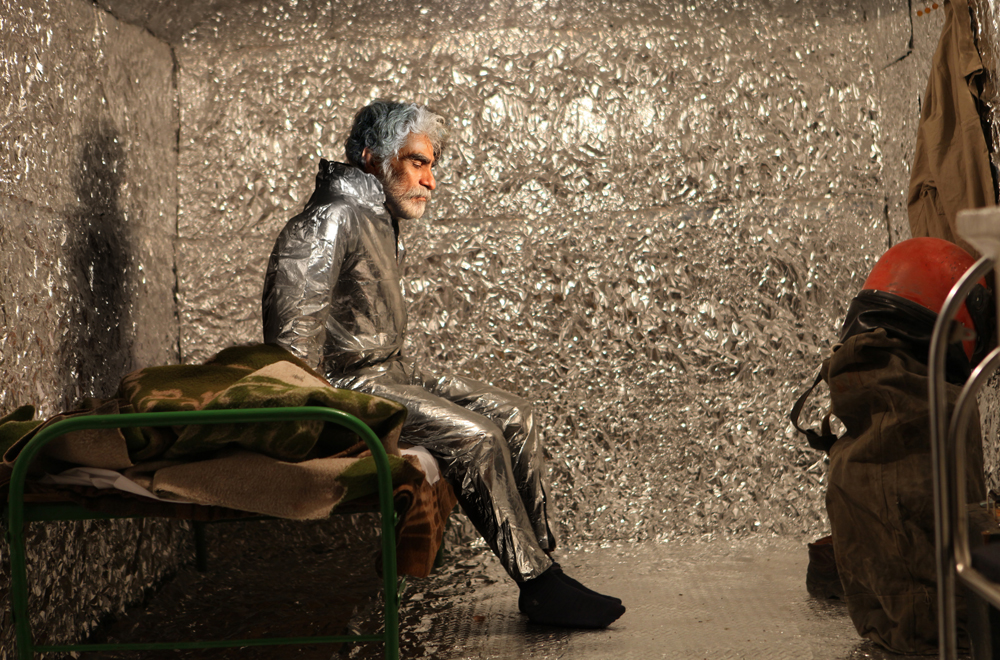
Taboor didn’t open the 2013 Edinburgh International Film Festival (an Iranian sci-fi film about a man who wears a tin-foil suit might have been a hard sell at the opening night gala), but it does at least have the honour of opening Geekzine’s coverage of said event.  Beautifully shot, with a glacial pace, precious little dialogue and a plot which invites the audience to fill in a number of gaps by themselves, Taboor could be said to typify the sort of pretentious art-house productions with which many modern film festivals (Edinburgh included) have become associated in the eyes of critics.  But to so dismiss this beguiling film from promising Iranian writer/director Vahid Vakilifar would be to do a disservice to a movie which, whilst at times almost infuriating in its cryptic meandering, is far from a mere exercise in self-indulgence.

The film opens in the home of its unnamed protagonist; a sparse single room apparently lined with tin-foil.  The man (Mohammad Rabbanipour) dresses in a suit of similar material before heading out into the night, travelling through an eerily silent Tehran to ply his trade as an exterminator, rooting out cockroach infestations in labyrinthine tower blocks and tumble-down suburban mansions.  As the film progresses, though, hints are dropped that the world of Taboor is not quite that of contemporary Iran, and these incongruities lead to a plethora of niggling questions.  The exterminator, it is revealed, wears his silver suit to protect against “microwaves”, but what is the source of these microwaves, and why does only he, out of seemingly everyone in Tehran, take this precaution?  He has no discernible means of communication, so how do his clients contact him?  Is he really living in a desolate, post-apocalyptic city or has he simply gone mad, and his clients and doctors are humouring him?  And what is the significance of the sadistic game he plays for money with the wealthy dwarf who lives in a vast, empty house?  Vakilifar provides no solid answers to the questions raised by his narrative, an approach which is simultaneously frustrating and ambiguously liberating.  The audience is thus invited to become a co-author in the film’s story, filling in the gaps as they feel appropriate to create myriad different interpretations.  One possible reading of the facts, though, does seem to point to a particularly plausible scenario.

The exterminator is the only character we encounter who dons a silver suit (and sleeps in a foil cocoon) to protect against microwave radiation.  Either nobody else in Tehran knows of the danger, nobody else cares about it, or nobody else is affected by it.  Additionally, the film pays subtle homage to the sci-fi cinema of yesteryear, with the appearance of copious amounts of the same tin-foil used to make ‘robot’ costumes in vintage films, and the brief passage of Vangelis’ Blade Runner soundtrack played as background music in one scene.  Taken together, these hints suggest that the exterminator is in fact a synthetic life-form, created for an unknown purpose, being slowly fried by microwaves from an unknown source, microwaves which leave his human peers unharmed.  But of course, this is merely one possible interpretation of Taboor, and there are other ways of reading the movie.

Despite its achingly slow pace and join-the-dots storytelling, Taboor remains a captivating film precisely because it forces the viewer to constantly reassess what they’re seeing.  Vakilifar’s choice of alien and futuristic locations within Tehran itself helps to unsettle assumptions about time and place, with spiraling metallic stairwells, underground generator rooms and the clunking, roaring grandeur of vast, implied mechanisms behind the city’s walls giving the impression of a world slightly stranger than our own.  Mohammad Rabbanipour uses only movement and facial expression to convey a profound but dignified sense of sadness on the part of the exterminator, and his performance anchors the film for its largely dialogue-free duration.  Because of these qualities, although Taboor is not an easy film to watch, it will reward those who stay the distance.

Taboor is showing Friday 21st June at 6pm (Cineworld), and Tuesday 25th June at 7.45pm (Filmhouse).

Jun 192013
 

The Last of Us is a journey and one which you will remember for a long time indeed.  But more than just a journey of getting from point A to point B, The Last of Us is as much an emotional and mental voyage as it is a physical one – well, virtually so.

I approached this game with high expectations, having been waiting a year for its release since the initial announcement at E3 2012, and boy was I not disappointed.  I mark a good game by its story and The Last of Us delivers this in spades, taking you on a trek across an America ravaged by a world-ending event.  But unlike the brown and decaying world of Cormac McCarthy’s brilliant novel The Road, this is a place where nature is taking back its hold, a landscape full of colour.  In other words, this is a world of potential hope, where things can be better than they have been in the past.

The Last of Us is one of the Playstation 3’s swan songs and quite simply a beautiful game.  Naughty Dog has shown its skill at creating a gorgeous setting for your adventure just like they did with their Uncharted trilogy – an utterly brilliant series which I cannot recommend enough.  It’s not just in the broad strokes of mountains and cities stretching into the distance which make this game shine, but in the fine details; the way the plaster has broken from a wall; the way the sunlight breaks to momentarily blind you; even the fingernails on a character’s hand!

I can count only a small number of games which have brought me close to tears by the way the story and characters affect me: the Mass Effect trilogy, Journey.  And similarly the number of games which fill me with fear and dread to open that next door: Silent Hill, Dark Souls, F.E.A.R.  The Last of Us made both happen within the first five minutes!  I won’t spoil it for you, but that moment when you think the worst has passed only to have it snatched away is a sneaky trick which works oh so well. Suffice to say, Naughty Dog has crafted a masterpiece of storytelling which makes you emotionally invested in the characters and crescendos to an intense but bittersweet conclusion.

Your protagonist for the majority of the game is Joel, a middle-aged man who has been left scarred and broken from the world-ending event.  He is a flawed individual and you initially find him difficult to like, but perhaps only because he is no stereotypical hero but simply a man trying to survive whilst suffering from his personal daemons. In fact, that bittersweet ending tells you so much about the character of Joel; he’s always fighting to stay emotionally distant, to protect himself from hurt.  You see him begin to hope, to care, which only leads towards the realisation that, selfishly, he refuses to let history repeat itself.  The story has built up your investment in the characters and you can tell what Joel is thinking, not only by his words and actions in cut-scenes, but even in the way the items you pick up allow you to be the brutal, one-man killing machine you want him to be under the circumstances.

Whilst you mostly control Joel, you really see the world through 14-year-old Ellie, Joel’s companion and the reason for his odyssey across America.  To Ellie, who has grown up in this dystopian world, life outside the quarantine zone is dangerous yet beautiful – her delight at the wild animals you observe is both wonderful and poignant.  Much like Joel, Ellie has her own emotional journey to take and you watch as she grows from a girl to a young woman who is moulded by the harsh environment surrounding her.  An intense moment in the middle of the last third of the story is perhaps one of the most telling in the entire game and sums up The Last of Us brilliantly – you do what you must to survive.

Whereas Joel is cold and distant, Ellie is warm and friendly.  Aptly this makes Joel’s actions throughout the game cold and calculated, whereas Ellie is much more emotional and consequently, brutal.  With Joel, killing becomes a routine but with Ellie, it’s so much more than that.

Gameplay is the only part that lets The Last of Us down, but to say that the gameplay is still stellar gives you an indication of just how sublime this game actually is.  Control is slick and precise as you navigate the world. Sequences swap between exploration, stealth and combat.  The moments when you have to decide whether to sneak past the Clicker – an infected who is blind but emits an eerie, shuddering clicking noise in order to navigate – or use your short supply of bullets to take it out, running the risk of attracting more of the infected, is tense.  The game does throw you a bone however with the ability to stop and listen to your environment, allowing you to see enemies through walls and giving you the opportunity to better plan your attack.  However, for the sake of immersion, you can switch this option off for a more realistic experience.  And it’s in this breaking of immersion where the gameplay is a let-down.  It doesn’t make sense why – in a sequence where you’re meant to be silent in order to sneak past infected – your companion is commenting away, or how enemies only seem to react to your presence and not the presence of your companions.  Now I suppose creating an AI good enough to actually simulate companions which are as skilful at keeping their head down as you is quite a big ask but still – it would have made the game so much more.  Nevertheless, if you can look past these discrepancies then you will enjoy The Last of Us as much as I did.

Survival in this harsh landscape involves rummaging for supplies wherever you are.  A simple but effective crafting system helps to emphasis the scarcity of items in the world, only allowing you to hold three of each supply and then, once crafted, only three med kits, shivs and homemade bombs.  The game never stops; entering your backpack to craft items or look over notes and other collectables does not pause the action, which adds an extra consideration when in the middle of a fire fight, realising you just used your last med kit and desperately needing to make another.  You can improve Joel’s skills along with upgrading your weapons, the latter only at the few and far between workstations.  However, with such short supplies it’s impossible to fully max out your skills and weapons in one play through, making every choice an important one.  Additionally, there is a plus game, allowing you to carry over your skills and upgrades to a plus mode.

The Last of Us is one of the most incredible games ever made.  It stands in my top five of games series – the Mass Effect trilogy, the Uncharted trilogy, Half-Life 2 and Shadow of the Colossus – and to say now two of my entries in the top five are by Naughty Dog just goes to show how much I love them.  I cannot wait for what they dream up next!

Tom Holland – Geekzine games writer