Jim Taylor

A ponderer with delusions of grandeur...

Nov 142012
 

When CBS announced its plan to produce a modern-day adaptation of Sherlock Holmes, the casting of Lucy Liu as a female Watson and the shift to a New York setting weren’t (despite the deluge of online negativity) particularly big problems for me.  As details about the upcoming series emerged, the question uppermost in my mind was simply, why bother?  Why bother to create an updated version of Holmes when the BBC had already succeeded so elegantly with Sherlock, and when there were already half a dozen shows on American television that either explicitly (House) or implicitly (The Mentalist, Lie To Me) featured clones of Holmes transplanted to a modern setting?  However well-plotted, well-acted and generally entertaining Elementary proves to be, I thought, it can’t overcome its sheer redundancy as yet another contemporary adaptation of Conan Doyle’s Sherlock Holmes stories.

But now three episodes of Elementary have been shown on UK television, it’s beginning to look like I might have misjudged the series.  The scripts are good but not brilliant; Jonny Lee Miller’s portrayal of Holmes is solid if a little too ‘humanised’; Lucy Liu’s performances remain barely credible at best, and the show’s general aesthetic hasn’t yet been distanced sufficiently from the raft of recent Holmes-clone police procedurals.  All these things I’d been expecting, more or less, but where I (and others) may have been mistaken is in assuming that Elementary would simply be a retread of Holmes’ classic cases in a modern setting, in the vein of Steven Moffat and Mark Gatiss’ Sherlock.  Clues are already starting to appear that suggest the programme makers may be more ambitious than I initially gave them credit for, because it looks like Elementary may actually be a sequel to the original Holmes stories, rather than simply an adaptation of them.

Let me explain.  I am not suggesting that Miller’s Holmes, instead of retiring to Sussex to keep bees (as in Conan Doyle’s His Last Bow), has somehow time-travelled to modern-day New York – becoming forty years younger in the process – to continue his detective work in a new setting (aside from being rather silly, such a concept would be eerily similar to the plot of Sherlock Holmes in the 22nd Century).  Rather, the story of Elementary is in fact an alternative take on Holmes’ retirement, only set in New York and featuring a considerably younger Holmes.  There are two pieces of evidence that support this interpretation:  First, characters in the series repeatedly mention Holmes’ previous career in London, one that ended with his having a drug-related breakdown and ending up in a rehab centre on the other side of the Atlantic.  This implies that, narratively speaking, Elementary in fact follows on from an updated version of the original Holmes stories, albeit one that we don’t actually see onscreen.  Second, in the very first episode it is revealed that Holmes keeps bee hives on the roof of his New York apartment.  As mentioned above, Conan Doyle had Holmes become a beekeeper when he retired, and so the inclusion of this element of the character by the makers of Elementary carries considerable symbolic significance, and suggests that what we’re seeing is in fact a speculative, contemporary take on what Holmes did next, after the final page of His Last Bow.

Elementary would not, of course, be the first work of fiction to speculate on the post-retirement career of Sherlock Holmes.  Michael Chabon’s The Final Solution and Alan Moore’s League of Extraordinary Gentlemen series, to name just two, have both featured storylines involving an elderly Holmes unable to quite give up his sleuthing ways.  But irrespective of its originality, the approach adopted by Elementary suggests that it’s a more ambitious show than I (and many others) have given it credit for.  Why bother creating a modern adaptation of the Holmes stories when the BBC’s Sherlock already exists?  Because Elementary is not an adaptation of those stories.  It’s the story that happened next, the one that never existed, where Holmes leaves London and instead of settling in Sussex heads across the ocean, looking for a fresh start.  Ignore the contemporary setting and Jonny Lee Miller’s youthful looks, and Elementary reveals itself to be an intriguing and alternative approach to adapting Sherlock Holmes.

Of course, this is only a theory, and there’s still plenty of time for the series to veer away from such an interesting course.  The temptation to feature Holmes’ nemesis Moriarty, for instance, will surely prove too great for the programme makers, although if they frame his appearance as a return from the dead akin to Holmes’ own, such a move could work within the confines of the ‘retirement’ concept.  It’s early days yet, and maybe I’m giving the show a little too much credit, but a take on Sherlock Holmes which is inspired by Conan Doyle’s original stories whilst being unencumbered by their constraints could prove to be a very interesting watch indeed.

‘Elementary’ is currently airing on Sky Living, Tuesdays at 9pm.

Nov 132012
 

Next summer’s zombie blockbuster looks epic in scope, but will it do justice to its celebrated source material?

After its original December release date was pushed back to June 2013 following two script re-writes and a reported seven weeks of re-shoots, internet doomsayers immediately began to predict that World War Z would be a cinematic train-wreck.  Just how much of a turkey the film might (or might not) be remains to be seen, but the release of its first official trailer at least gives us some proper footage to chew over.  So the question is, how does it look?

While it of course remains a possibility that the film will end up a convoluted mess, the trailer is admittedly impressive.  Glasgow city centre has never looked so awe-inspiring, and the exotic locations and myriad actors featured suggest that World War Z will be a zombie film much more epic in scope and ambition than most others of its ilk.  As Brad Pitt’s UN investigator travels the globe covering the ongoing zombie world war, it appears we’ll be treated to sequences of small-scale survival-horror as well as large-scale battles featuring heavily armed soldiers and thousands of CGI flesh-eaters.  Having a scope of such mammoth proportions also characterised the Max Brooks novel upon which the film is based, but it is here, however, that the similarities between source material and adaptation seem to end.

One of the things that makes Brooks’ novel so compelling is the fact that it is not just one man’s account of a fictional zombie world war, but rather an oral history featuring the accounts of multiple survivors from various different countries and walks of life.  The investigator character in the book is a neutral voice, largely serving as a framing device so that characters from China, Russia, India, South Africa and elsewhere can tell their gripping stories of survival and sacrifice.  With Brad Pitt in the role, it’s understandable that the investigator (a role played by Brooks himself in the book) would have a bigger part to play in the movie adaptation, but from what little we can see in the trailer, it seems that Pitt’s character has actually become the focal point of the film, with the tragedies and triumphs of the zombie war all brought to the viewer from his perspective.  If this is so, it means that a key component of what made World War Z a great novel will have been lost in the process of adaptation.  By placing its emphasis on the perspective of a lone American reporter, the film will lose the thoroughly international character of its source material, and will be the poorer for it.

It is by no means certain that World War Z will suffer such of a narrowing of perspective, but the lack of a truly multinational ensemble cast suggests that it might well be the case.  In bowing to the whims of Hollywood, and focussing on the American point of view, the film-makers risk taking the ‘world’ out of World War Z.

Nov 042012
 

With their episodic, crisis-of-the-week approach to storytelling, you’d think that comic books would have found their natural visual media outlet in television, rather than in the numerous film adaptations which continue to net big bucks for major publishers like Marvel and DC.  The wealth of elaborate backstory and character development in most long-running comics can only be hinted at in a two-hour movie, with no opportunity to slowly build complex story-arcs in the way that a variety of TV shows on networks like HBO and AMC have recently done so well.  But despite this fact, the only notable success story of televisual superheroics in recent years has been the The CW network’s Superman adaptation Smallville, whose tenth and final season ended last year.  Other recent attempts at bringing superheroes to the small screen, such as 2002’s Birds of Prey, 2006’s Blade: The Series and 2011’s Wonder Woman have all died a quick death, due either to network apathy or sharply declining ratings during their first season.   It is perhaps not surprising, then, that for such a seemingly risky venture as a new superhero TV series, The CW have chosen a hero who’ll be familiar to Smallville viewers after appearing as a supporting character on that show, but who is also obscure enough to feel fresh to casual fans of superheroics.  This character is of course none other than Oliver Queen, better known as his alter-ego Green Arrow.

The premise of Arrow is simple; after being stranded on a remote island for five years, billionaire playboy Oliver Queen returns to his family in Starling City a changed man.  Having (mysteriously) developed a range of deadly combat skills during his time in the wilderness, as well as an impressive proficiency with bow and arrow, Queen sets about dispensing vigilante justice to a group of corrupt and exploitative businessmen, whose hold over the city has become so strong that even the police can’t touch them.  In order to protect those close to him, Queen disguises himself in a hooded green costume during his nightly excursions, and continues to act the part of a hedonistic rich-kid when in public, all the while trying to find a way to reconnect with the family who spent five years thinking he was dead.

Two episodes of Arrow have now aired in the UK, and we can begin to get some sort of idea about the series’ take on the character of Green Arrow.  In general, the show has thus far been of a reasonably high quality.  The acting has ranged from passable to powerful (bolstered by the presence of veteran Brit thesps Colin Salmon and Paul Blackthorne), with Stephen Amell doing a good line in brooding intensity as the eponymous crime fighter, and the action sequences are engaging and generally well-shot.  There are, however, two areas where the show falters slightly; first, in its depiction of the Queen family’s home life, which has veered too close to soap opera on several occasions, and second (and more importantly) in its depiction of Oliver Queen himself.

The Green Arrow familiar to readers of DC comics originally began in 1941 as little more than a Batman analogue with a bow and arrow, until writer Denny O’Neil’s celebrated reinvention of the character in the 1970s.  O’Neil refashioned Oliver Queen as a wealthy hedonist who develops a passion for social justice and left-wing politics after his own fortune is taken from him and he comes to better appreciate the plight of the poorest members of society.  In the decades since, these polemical views have come to define the character, moving him further away from being simply a Batman clone while simultaneously bringing him in line with the philosophy of Robin Hood, the legend which also inspired both the character’s costume and his choice of weapon.  But even a change as innocuous as the omission of the word ‘green’ from Arrow‘s title seems to indicate that the show is striving to be darker than its comic book origins, and early episodes confirm that the template for the show’s take on Oliver Queen owes more to the gritty realism of Christopher Nolan’s Batman than it does to DC’s Green Arrow.

This is hardly surprising; Nolan’s Batman films have been runaway critical and commercial successes, so it makes sense that DC (and The CW) would attempt to replicate this success on the small screen by applying Nolan’s stylistic palette to a different character, one little-known enough to act as a blank slate.  The problem is, such an approach is in danger of once again reducing Green Arrow (on screen, at least) to little more than a Bat-clone, and a morally dubious one at that.  While the Oliver Queen of the comics is a principled, compassionate man defined by his politics, the TV version kills his enemies’ henchmen without a second thought, and wages war against the capitalist criminals of Starling City not out of a desire for social justice per se, but to atone for the sins of his dead father, who was once among their number.  In making Oliver Queen an ice-cold killer driven by a personal vendetta, the show’s writers run the risk of creating a character too dark to elicit audience sympathy, as well as straying too far from his comic book origins.  Of course, there’s no reason why the show’s creators should slavishly adhere to all the conventions of the character’s print history, but if they plan to strip Green Arrow of the essential elements that make the character who he is, then the use of his name begins to seem cynically cosmetic; merely an attempt to cash in on the character’s pre-existing fanbase.  Arrow, while far from perfect, is a thoroughly entertaining TV series, and therefore deserving of your attention.  But only time will tell whether the show’s writers will do enough to give Oliver Queen an identity of his own, and make him more than just Batman with a bow.

‘Arrow’ is currently airing on Sky1, Mondays at 8pm.


Oct 302012
 

It wouldn’t be Halloween without horror movies, but if you’ve already been spooked by classics like Halloween and The Exorcist and shocked by newer fayre like Paranormal Activity and [Rec], there are plenty of underappreciated horror gems out there waiting to be discovered by intrepid film fans on a dark October night.  This Halloween, Geekzine UK presents to you a small selection of recommended horror films that you may have previously overlooked, due either to their relative obscurity or their (unfairly) poor reputation in critical circles.  Ranging from fairly conventional monster movies to surreal odysseys into the unknown, they’re none of them flawless, but all of them have that essential ingredient for a suitably creepy cinematic experience….atmosphere!  Enjoy some alternative horror this Halloween; there’s more than one way to scare yourself witless!


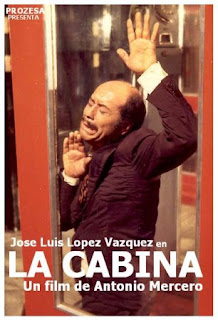
La Cabina (1972)

Watch the trailer (Youtube)

In just 35 minutes, this Emmy award-winning Spanish short directed by Antonio Mercero manages to build more tension than most feature-length films.  A simple story about a man trapped in a phone box becomes a terrifying ordeal as a creeping sense of dread begins to infect the film, and the main character starts to realise the true horror of his situation.  Eschewing any explicitly supernatural elements, La Cabina can be seen as a satire on the banality of bureaucratic evil, but works best if experienced purely as a horror story, albeit one of a most unusual kind.


C.H.U.D. (1984)

Watch the trailer (Youtube)

In spite of its horrendous title, C.H.U.D. is a hugely entertaining – and surprisingly well-made – monster movie.  John Heard and Daniel Stern would later reunite in Home Alone (albeit without sharing a single scene), but here they play two men investigating gruesome attacks in New York’s sewers in an altogether different type of film.  The concept of mutated, homeless cannibals dwelling beneath the city streets is proper B-movie fodder, but it almost seems as if everyone involved with the movie forgot that they were making a terrible film and turned in solid performances instead!  The creature make-up is dated but still effective, and the labyrinthine sewer sets make for an eerie backdrop to this underrated classic.


Prince of Darkness (1987)

Watch the trailer (Youtube)

You might be surprised to see one film – let alone two – from legendary director John Carpenter (“The Master of Fear”) on a list of alternative horror movies, but for every Escape From New York and The Thing, there’s a lesser-known movie in Carpenter’s oeuvre that hasn’t developed the cult following some of his other works have, and they aren’t all as bad as Ghosts of MarsPrince of Darkness may have been a critical failure upon its release in 1987, and seen as a relatively poor film in comparison to much of Carpenter’s earlier work, but despite some dodgy plot logic and even dodgier facial hair, this story of physics students investigating a demonic artefact buried beneath a church makes for a thrilling watch.  The film has a fantastically creepy atmosphere, aided by Carpenter’s unsettling synth score, a great performance from Donald Pleasence as a conflicted priest, and some profoundly disturbing hand-held camera sequences.  Plus, there’s a cameo from Alice Cooper!


In the Mouth of Madness (1995)

Watch the trailer (Youtube)

The second John Carpenter film on this list is another underrated gem, and actually represents the best attempt yet by a director at adapting the work of H.P. Lovecraft for the big screen.  The film isn’t an actual Lovecraft adaptation, but the mysterious and sinister figure at its centre, horror writer Sutter Cane (Jurgen Prochnow), whose books turn those who read them into psychotic killers, is an obvious analogue for the master of atmospheric eldritch horror, and the dark and ancient beings who orchestrate the film’s apocalyptic events are clearly influenced by the Great Old Ones of the Cthulhu mythos.  Sam Neill puts in a fine performance as an investigator sent to rural New England to track down Cane and his latest manuscript, only to discover the terrible truth about his own reality and an unspeakable plot to end the world….or so he thinks.


Gozu (2003)

Watch the trailer (Youtube)

Easily the most surreal entry on this list comes courtesy of notorious Japanese auteur Takashi Miike, with his utterly bizarre horror film Gozu.  Minami (Hideki Stone) searches a small town for his lost friend Ozaki (Show Aikawa), a brutally violent gangster, and encounters a strange and disturbing array of characters who may or may not be to blame for his friend’s disappearance.  Minami’s odyssey eventually brings him into contact with a cow-headed demon (the eponymous Gozu), with whom it seems Ozaki may have made a deal to ensure his own transformation and rebirth.  At times the film is almost maddeningly abstract, with several key plot points seemingly left open to interpretation, but Miike manages to maintain a nicely eerie and ethereal atmosphere throughout, occasionally punctuated with some truly shocking scenes.  The bonkers nature of the trailer gives a good idea of what viewers are in for, but Gozu can be a rewarding watch if you’re willing to take it on its own terms.


The House of the Devil (2009)

Watch the trailer (Youtube)

If you weren’t already aware that House of the Devil was made just three years ago, you’d be hard-pressed to date it accurately merely by watching.  Director Ti West strove to recreate the style and atmosphere of the classic horror films of the 1970s and 1980s, using 16mm film and a range of cinematographic techniques typical of the period, and succeeded in creating a movie that looks and feels as though it was made thirty years ago.  College student Samantha (Jocelin Donahue) takes a babysitting job at a foreboding house on the edge of town, home to the deeply sinister Mr Ulman (the ever-creepy Tom Noonan) and his family.  All Samantha has to do is sit downstairs and watch TV, but of course her curiosity gets the better of her and her journey into the upper reaches of the house becomes a prolonged and terrifying ordeal.  Despite being an obvious homage to many classic horror films of the last few decades, House of the Devil never feels stale, and features a level of finesse and attention to detail frequently absent in many modern shockers.


Go on then and take a step out into the unknown, but don’t say we didn’t warn you!  And just in case these six films aren’t sufficient to satisfy your bloodlust, as an added bonus we’ve included this list of miscellaneous recommended titles from the forgotten vaults of underrated horror classics (in no particular order), compiled by horror aficionado and friend of the Geekzine, Wayne Thomson:

From Beyond (1986), Legend of Hell House (1973), The Reptile (1966), Freaks (1932), Who Can Kill a Child? (1976), Inferno (1980), Zombie Holocaust (1979), Cannibal Apocalypse (1980), Q – the Winged Serpent (1982), Anguish (1987), Lifeforce (1985), The Funhouse (1981), Frightmare (1974), Xtro (1982), The Witch Who Came From the Sea (1976), The Exorcist 3 (1990), Stage Fright (1987), Martin (1976)

Careful, though; most of these are not for the faint of heart (or stomach)….

HAPPY HALLOWEEN!!!

Oct 292012
 

Ever wondered how your favourite fictional characters would fare against each other in a brutal fight to the death?  Of course you have!  Many’s the pub debate that’s revolved around the martial prowess of Mr Tickle, or the hand-to-hand combat proficiency of the supporting characters of Space Precinct.  But now such vulgar speculation can be replaced with grim certainty, thanks to the efforts of the Fight! Fight! Fight! blog.

Every Monday, a new bout of bloody conflict is resolved, a victor declared and a whole swathe of childhood dreams shattered, as two (or sometimes three) characters from the fictional realms go head-to-head and attempt to beat each other into submission.  Recent fights have included Thornton Reed (of Garth Marenghi’s Darplace) vs Mr Tumnus (of Narnia), and Jigglypuff (the Pokemon) vs Rorschach (of Watchmen).  In a cascade of violent surreality, the FFF blog scientifically calculates the predicted outcome of each match-up, and then writes about it in gruesome (and amusing) detail.

So, if you’ve a burning desire to know who would win in a fight between Colonel White and Nick Fury, or who would emerge victorious from a gory three-way match between Alan Tracy, Wesley Crusher and Adric, then this is the blog for you!

Because fictional violence is cool, and crossover fictional violence is even cooler.  Obviously.

Oct 112012
 

Comic-Con 2011 saw – amongst other things – the premiere of one particular film trailer which set geek hearts everywhere racing.  With its simple but brilliant premise of a group of live-action role-players accidentally summoning a real demon, and the comedic horror which looked set to ensue, the three-minute teaser for Knight of Badassdom generated a feverishly enthusiastic response from the San Diego audience.  The fact that the film also boasted an quality cast of genre stalwarts didn’t hurt either.  Summer Glau (Firefly, Terminator: The Sarah Connor Chronicles), Ryan Kwanten (True Blood), Peter Dinklage (Game of Thrones) and Danny Pudi (Community) make up one of the most geek-friendly casts ever assembled, and their appearance as hapless LARPers battling real-life hellspawn further enhanced fans’ expectations of the film.  As can be seen from the trailer, everyone looks like they’re having a ball (especially Dinklage):

But over a year after that Comic-Con panel, Knights of Badassdom is nowhere to be seen.  It hasn’t been given a cinematic release, nor has it appeared in the direct-to-DVD market.  The status of the film (according to IMDB) – unchanged for the last twelve months – is “post-production”, and the film’s Facebook page is full of unanswered posts from increasingly angry fans demanding a release date.  The film’s official website features only the trailer and a clutch of media quotes, with a caption below the video simply stating:  “Coming 2012”.  With less than twelve weeks to go in 2012, it doesn’t look like the film will be getting either a cinematic or DVD release this side of the new year, so just what on earth has happened to it?

Could it be that the studio’s funding has collapsed, or that negative test screening feedback has led to reshoots or – worse still – the film being shelved by its producers?  Let’s not forget that just a few months ago, Paramount Pictures took the surprising decision to delay the release of G.I. Joe: Retaliation by almost a year, little more than a month before the movie’s originally scheduled release date, ostensibly to give more post-production time to the 3D conversion process.  Could something similar (though on a much smaller scale) have happened to Knights of Badassdom?  It would make little sense if the delay was a deliberate tactic on the part of the film-makers rather than a technical hitch; with the actors involved already having cemented their places as genre fan-favourites, and Peter Dinklage’s star in particular already well in ascendancy thanks to HBO’s mega-popular Game of Thrones, it’s difficult to see what they could be waiting for.  What’s more, David Wain’s Role Models has already shown that a comedy film (partly) about live-action role-players can be commercially successful, and the overwhelmingly positive media and fan reaction to Knights of Badassdom‘s Comic-Con trailer suggests that it could well follow suit.  So again; why the delay?

Answers are not easy to find, but a recent report by Dread Central seems to shine some light on the issue.  Queries put to the film’s director and producers about the current status of the film were met with professions of ignorance, and a suggestion to direct enquiries to IndieVest Pictures, the studio which financed the film.  Eventually, the intrepid writer managed to get someone on the phone who claimed to be the CEO of IndieVest, Wade Bradley.  Bradley claims that the film has been in post-production for the last year, but that it is nearly ready to be released and that his new venture, dubbed ‘Media Society’, will be officially releasing the film in “the first half of 2013”.  All well and good, but it’s hardly an official press release, and if you read the article it seems as though Bradley is being a little bit fuzzy with the details.  What’s more, there’s a suggestion of financial difficulties at the studio, with (admittedly unconfirmed) rumours abounding that Media Society’s creation is just an elaborate way to avoid financial obligations to Knights of Badassdom‘s original backers, and the sheer length of time the film has been in post-production suggesting that IndieVest may have run out of money at some point during the process.

So where does this leave Knights of Badassdom?  The official word seems to be that the film is set for a (limited) cinematic release in early 2013, but we may have to take this with a pinch of salt as the details remain somewhat murky.  What is certain is that, thanks in part to the almost mythic character the film has now acquired, it already has a sizeable fanbase waiting for the day of release….but they won’t wait forever.  Further delays to the movie could jeopardise its potential success, and squander the grass-roots fan support which began to grow after the debut of that trailer at Comic-Con 2011.  In other words, it’s in everyone’s best interests for Knights of Badassdom to be released soon.  I for one am looking forward to what looks like a hugely enjoyable movie, and hoping that it doesn’t end up permanently mired in development hell.

 Jim “Having a LARP” Taylor, chief literary correspondent, geekzine UK