Jim Taylor

A ponderer with delusions of grandeur...

Oct 012012
 

https://dwtr67e3ikfml.cloudfront.net/bookCovers/ff455922b229c1bcd00892ed418a906375046ce3

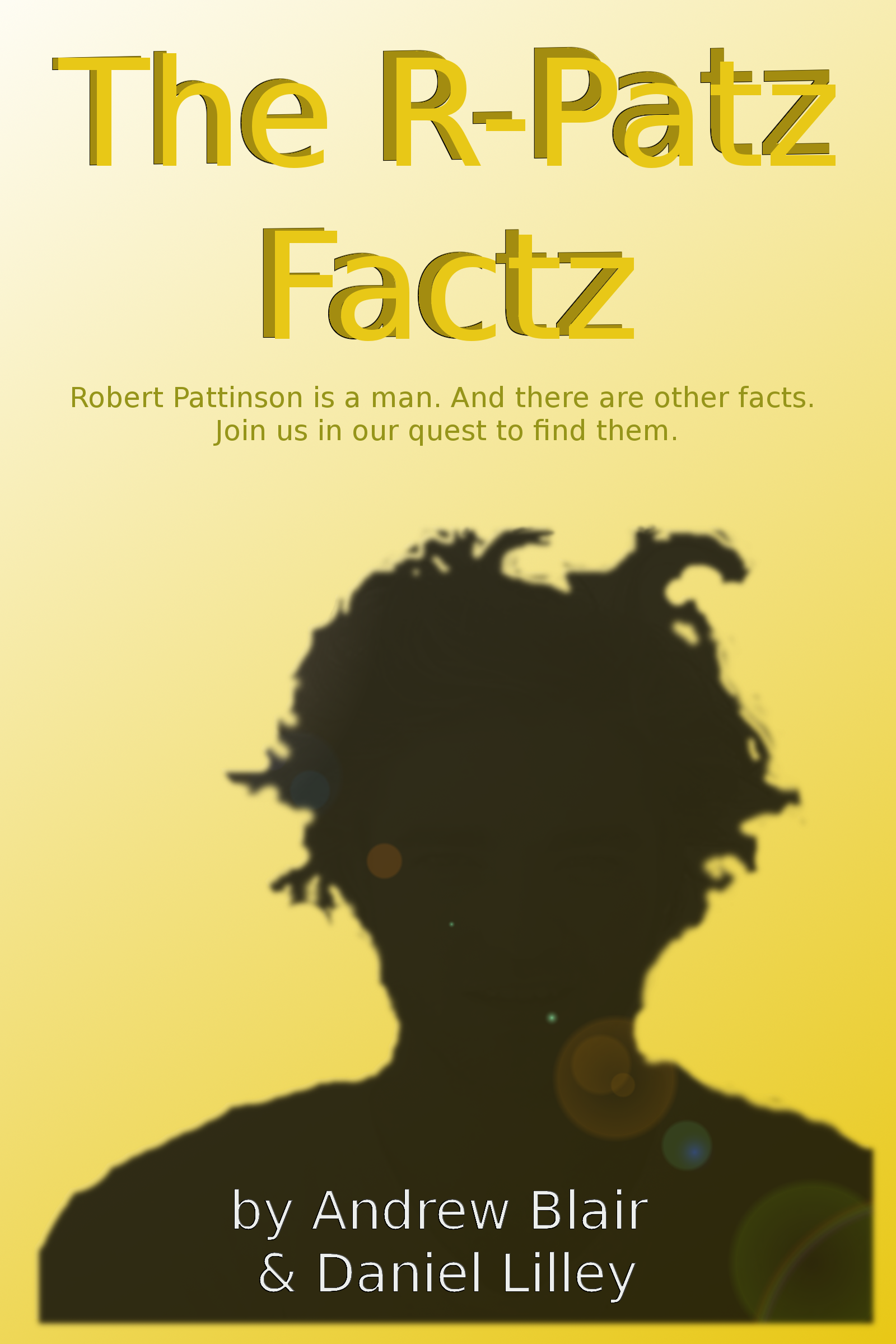
The R-Patz Factz is – as the name suggests – a book of facts about the actor Robert Pattinson, he of Twilight, Harry Potter and Cosmopolis fame.  The thing is, none of these ‘facts’ are actually true (as far as we know).  This is because the book is in fact a work of parody, and while any bookseller will tell you that the vast majority of so-called ‘humour’ titles are not worth the paper on which they are printed, The R-Patz Factz offers more than a few genuine laughs despite its short length.

A list of made-up facts about a Hollywood actor may seem like a strange premise for a book, and indeed it is.  Divided into eighteen chapters, including Early Years, Acting, Language, Sex and Unfortunate Misunderstandings, these ‘facts’ range from the slightly weird to the outright bizarre, and some are just plain disgusting!  Not every one of them hits the mark comedically, but they’re delivered in such rapid-fire fashion that every page features several laugh-out-loud moments.  Some are funny due to nothing more than their sheer surreality, and some thanks to a nifty turn of phrase, but most display the sort of delight in wanton absurdity that characterises the work of authors like Douglas Adams and Robert Rankin.  Some choice examples include:

Robert Pattinson’s house has a room where the surfaces are covered with pages detailing the the whereabouts of the duck in every Usbourne book.

Robert Pattinson was banned from playing cricket in the Greater London District schools tournament after he was found guilty of using a Quantum Kraken to be everywhere at once.

Robert Pattinson has submitted fourteen comics to 2000 AD, all featuring Robot Pattinson, a charismatic acting-bot who solves sexy crimes.

Robert Pattinson doesn’t trust cheese.  Sometimes it has holes in it, sometimes it doesn’t.  ‘If people were like that, what would you say?’ he says.

Of course, the fact that it is specifically Robert Pattinson at the centre of this book is effectively inconsequential; such humorously surreal titbits could be written about any person, real or fictional, and maintain their comedic impact.  But the fact that the book’s subject is the man who brought Edward Cullen to life on the silver screen does seem to add to the amusement, as do a series of crude (and somewhat grotesque) illustrations giving visual representation to some of the more disturbing ‘facts’ listed throughout the book.

The R-Patz Factz will not be to everyone’s tastes, but its authors have succeeded in creating an amusing distraction which is best appreciated for the harmless bit of fun that it is.  It’s short at only thirty pages, but you’re guaranteed a few good laughs along the way.

The book is available in a variety of digital formats from Smashwords here.

Jim Taylor, Chief Literary Correspondent, www.geekzine.co.uk

Sep 262012
 

Busy Gardens

Across 17 days in August, approximately 225,000 people visited this year’s Edinburgh International Book Festival in Charlotte Square Gardens – a massive number by any reckoning.  Such popularity is perhaps not a surprise; with a programme which featured hundreds of authors, EIBF 2012 really did have something for everyone.  But how was the geek community served by this diverse range of literary events?  Sci-Fi, Fantasy and Horror are genres which are slowly garnering some much-deserved recognition in literary circles, or at least are beginning to lose the negative stigma which has dogged them for so long, and the graphic medium of comic books is – through the efforts of writers like Grant Morrison  – gradually starting to become accepted as a legitimate art-form by many book readers.  Was this new-found respectability of geeky subject matter reflected in the (apparently) diverse programme of EIBF 2012?  I took to the muddy fields of Charlotte Square to find out, and found five events in particular that caught my eye….

Neil Gaiman and Chris Riddell were in attendance at the festival to discuss the 10th Anniversary edition of Gaiman’s modern children’s classic Coraline,  featuring illustrations by Riddell.  Both men were their usual, affable selves, and clearly enjoyed talking at length about the history of the book, a project which Riddell described as “a joy to do”.

Coraline, Gaiman told the audience, was a book he had started to work on back in 1991, in an attempt to fulfil his daughter’s desire for “weird horror for 4-5 year olds”.  Owing to a lack of free time he didn’t complete the novel until the turn of the century, but this, he said, only taught him the virtue of putting a project on hold.  The UK edition of the book was originally published without illustrations, while the American edition featured the work of artist Dave McKean.  Riddell praised Bloomsbury’s decision to publish later editions in the UK with illustrations, as Gaiman’s work, he said, was characterised by the sort of “relish for storytelling” which illustrators find very inspirational.

Asked about his influences when writing Coraline, Gaiman named the obscure Victorian writer Lucy Clifford, a children’s author who wrote rather odd and disturbing stories.  In particular, he said, her dark and sinister tale The New Mother had stayed with him during the writing of the book.  For his part, Riddell said that it was impossible for him not to be influenced by the previous work of McKean and Henry Selick (director of the Coraline film adaptation) when illustrating the book, but that he hoped he had managed to bring something fresh to the project.  

Both men were also able to talk a little about their upcoming releases.  Gaiman has two novels coming out in 2013, one intended for children (Fortunately the Milk) and one aimed at the adult market (The Ocean at the End of the Lane).  Riddell revealed that he is currently working on what he called “a gothic novel for 8 year-olds”, with the tentative title of Goth Girl.  The undoubted highlight of the evening, though, was Gaiman and Riddell’s new “party trick” of live illustration.  In an effort to bring a bit of variety to the somewhat tired concept of an author reading, Gaiman read a chapter of Coraline aloud while Riddell rendered an appropriate illustration via paper, pen and projector simultaneously.  In this one sequence of madcap originality, the two men managed to encapsulate what it is about their work that continually enchants readers both young and old.


Glaswegian comics legend Grant Morrison opened his talk at the festival by pleading for a expedited signing session at the end of the night, as last year’s mammoth meet-and-greet apparently went on until 2 o’clock in the morning(!).  True to form, the graphic novel guru was in high spirits, and kept a rapt audience amused with his outlandish anecdotes and opinions, despite some rather plodding and uninspired questions from chair Adrian Searle.  Morrison discussed at length the many themes and ideas which characterise his book Supergods, the paperback edition of which has recently been released, including cyclical trends in comic book fashion, the possible reasons for differences between British and American comics, and the demonisation of comic books during the middle years of the 20th century, when they had, in Morrison’s words, no-one to defend them.

But as well as being a history of superhero comics, Supergods is also part memoir, and Morrison was also able to discuss and answer questions on his own experiences of the industry and his dreams for the future.  What fascinates him as a writer, he said, are the epic, symbolic possibilities of superheroes, and their place in the pantheon of “pop mythology”.  Such god-like characters can easily take on a life of their own, and their stories can have great allegorical resonance with our own experiences in the real world.  Despite this fact, though, Morrison insisted that he has always been more interested in exploring the vast possibilities of fictional comic book universes than attempting to infuse superheroic characters and storylines with the gritty realism that became so popular in the comics medium in the wake of Alan Moore’s Watchmen and Frank Miller’s  The Dark Knight Returns.  Comic books, he insisted, should evoke a feeling, like music does, rather than attempt to deal with specific issues.

Asked about his influences, Morrison explained that he draws inspiration from every medium imaginable, not just other comic books.  Prose writing, TV, film, music and painting all featured in his list of influences, with music in particular (as any fan of his work will know) playing a particularly major role.  Teasing the audience with promises of many more books to come in the near future, and hinting at some TV work currently in progress, Morrison achieved that rare feat of fulfilling an audience’s desires while still leaving them wanting to hear more.

As well as giving a powerful and provocative speech at the Edinburgh International Writers’ Conference on the future of the novel, China Miéville also found time during his stint at the festival to chat to fellow author Patrick Ness about both his latest novel Railsea and the state of literature in general.  He described the young adult novel as his take on Moby Dick, based on two jokes; “moles instead of whales” and “trains instead of ships”.  Describing his writing process, Miéville said that instead of starting with the characters and working outwards (as many authors do), he tends to start with an image that has emotional resonance, and then build his story on top of it.

In recent years, Miéville seems to have been elected as the unofficial spokesperson for geek writing in literary circles, almost against his will.  That said, he’s a man who enjoys a good debate over controversial issues, and his talk with Ness inevitably turned to the hot topic of literary genres.  Miéville insists that ‘genre’ writing (in other words, Sci-Fi/Fantasy/Horror/Crime etc) has an important role to play within the wider literary experience, due to its capacity for “startling” the reader, and playing with the traditions and protocols that can act as straitjackets for many authors of so-called ‘literary’ fiction.  Genres, he said, do not really exist, but they do have a presence, and in spite of their apparently ‘liberated’ nature have their own particular sets of protocols which truly creative writers must be prepared to play around with.

Despite his reputation as a abrasive polemicist, Miéville came across as funny and down-to-earth, quite willing to poke fun at his own self-aggrandising tendencies.  Essentially, he said, he’s a man who writes books because he wants “to invent monsters”, and feels that the burden is upon himself to continually prove to readers that his work remains interesting and thus worth picking up.  Ever ready with a surprise up his sleeve, when asked about his favourite book the geek guru replied sincerely that it was Charlotte Bronte’s Jane Eyre.            

Readers who aren’t long-time fans of the work of Kim Newman (or who perhaps only know him as a film critic) might be surprised to learn that Anno Dracula, the first volume of his planned five-part vampire saga, was actually first published in 1992.  The recent republication of the novel by Titan Books (along with its sequels The Bloody Red Baron and Dracula Cha Cha Cha) has drawn new attention to this epic alternate history series, which takes inspiration from myriad fictional works of the last 150 years as well as actual historical events.  In anticipation of the publication of the last two books in the series – next year’s Johnny Alucard and an as yet untitled fifth book – Newman discussed his approach to writing with former colleague Rodge Glass at this year’s festival, and also talked about a number of other projects from his long and prestigious career.

According to Newman, his aim when creating the series was to write stories that dealt with real historical events such as Jack the Ripper, the birth of tabloid journalism and society’s drift towards totalitarianism, as well as playing with the various forms of Victorian pulp fiction and celebrating the genre which Bram Stoker began in 1897 with Dracula.  His desire to create a more nuanced vision of a vampire/human society had, he said, led him to expand the story begun in the first book into one long “mosaic” of a series, covering the whole of the 20th century and some of the 19th.  There are also, Newman explained, some “pretty serious discussions” going on just now about a possible film adaptation of the books, but this, he recognises, will be a long and painful process.

Not content to stick to writing prose fiction, Newman said that he likes to take on something new every year.  He and Glass spoke briefly about the plays he has written this year for both stage and radio, both of which have a distinctly horrific vibe to them, as well as the various non-fiction titles that he has produced during a long and fruitful career.  The Anno Dracula series, though, of course continues to unfold, and Johnny Alucard (released early 2013) will concern – amongst other, more gruesome things – the making of Dracula movies; surely a subject close to the heart of a man who spends much of his time writing film criticism.

The final geek-worthy event of the festival was Will Brooker’s talk about his new book, Hunting the Dark Knight.  As will be obvious from the title, this book is all about Batman, and Brooker (based at Kingston University) is in fact the pre-eminent academic authority on the caped crusader, having previously written the 2001 title Batman Unmasked (originally his PhD thesis), as well as texts on Star Wars and Alice in Wonderland.  The time was right, Brooker said, for a second Bat-book because three major developments had occurred in the intervening years which have had a considerable impact on the ways in which Batman is written and interpreted; the September 11th terrorist attacks, Christopher Nolan’s film adaptations of the character, and Grant Morrison’s groundbreaking run on the monthly Batman comics.

Brooker argues that, as Morrison attempted to convey during his tenure on the comic, Batman is not simply a character, but rather “an archive, a matrix, a mosaic”.  If we consider the various incarnations of the character during his 73 years in print, from his pulpy origin to his camp ’60s heyday and his dark ’80s rebirth (and beyond to Nolan and Morrison’s versions), it becomes apparent that insisting upon the ‘authenticity’ of one particular version of the character merely reduces or “imprisons” him.  The fact that there is not just one Batman, but many Batmen is one of the key reasons why the character has remained a vital part of popular culture over the last eight decades; the flexibility of the “man who walks with gods” (as a member of DC’s Justice League of America) meaning that Batman can be many things to many people.  This struggle between the many different Batmen is something which Brooker deals with in his writing, as well as critical literary analysis of the role of authorship in the Batman comics, and cultural commentary concerning what Batman can tell us about the world we live in, and how that world is reflected in the “distorted mirror” of Gotham City.  And if Hunting the Dark Knight is half as entertaining as Brooker’s festival talk, it’ll also be a hoot to read.

Early evening sunshine

Superheroes, giant moles, vampires, Batmen?!  As the sun set on the Edinburgh International Book Festival 2012, it became apparent to this correspondent that the festival programme had indeed featured a good selection of events to cater to everyone’s inner geek.  This annual festival is a tremendous and important undertaking, featuring hundreds of events which attract thousands of visitors, and it is only right that it celebrates the myriad authors who create wonderful and exciting work in what we might call geek-friendly genres and styles.  It still seemed to me, however, that such authors were somewhat under-represented at EIBF 2012, and we can only hope that their presence continues to grow at future festivals, for as China Miéville reminded us, so-called ‘genre’ fiction has an important role to play in “startling” readers out of their comfort zone, and sometimes we all need a good startling.

Jim Taylor, Chief Literary Correspondent, www.geekzine.co.uk

 

Jul 112012
 

This year the organisers of the Edinburgh Film Festival decided to bring back the popular ‘Surprise Movie’ event which has been absent from its programme for the last couple of years.  The event was a sell-out, and as the audience settled into their seats before the film began there was a palpable sense of excitement in the cinema.  It is just this sort of electric atmosphere which accompanies a real sense of event – one which befits a festival setting – that the EIFF has arguably been lacking for the last few years, and it was nice to get the sense that we, the audience, were in for something special.  As the lights dimmed, that something special was revealed to be the new film from Australian director John Hillcoat; Lawless.

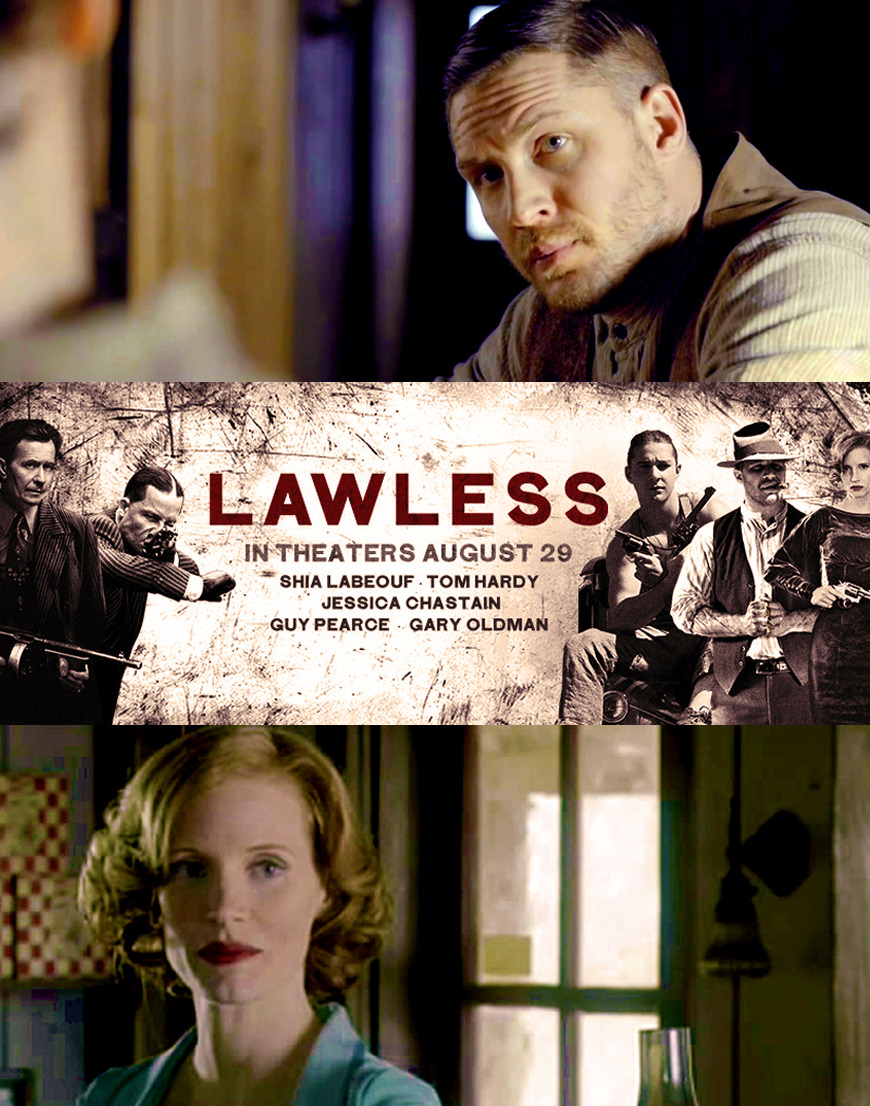
Fresh from the critical triumph of his rendering of Cormac McCarthy’s post-apocalyptic thriller The Road, Hillcoat has re-teamed with prolific musician and writer Nick Cave, who scripted the gritty Australian western The Proposition for the director back in 2005.  Lawless is the new fruit of their continuing collaboration; a prohibition-era crime drama set in rural Virginia which proves to be a perfect showcase for the director’s twin recurring themes of bleak landscapes and morally ambiguous protagonists.  Based on Matt Bondurant’s historical novel The Wettest County in the World, the film tells the real-life story of the Bondurant brothers (Tom Hardy, Jason Clarke and Shia LeBeouf), a family of bootleggers who run moonshine across county lines and turn a tidy profit.  But times are changing, and the steady stream of gangsters, cops and runaways fleeing the blood-soaked streets of Capone’s Chicago bring with them new challenges to the brothers’ way of life.  Glamorous gangster Floyd Banner (Gary Oldman) presents a fresh but risky business opportunity, former dancer Maggie (Jessica Chastain) a possible romantic entanglement, and monstrous Deputy Charley Rakes (Guy Pearce) an ever-growing threat to both the Bondurants’ business and their lives.  Against this backdrop of crime and conflict, the youngest brother, Jack (LeBeouf) slowly comes of age, and through his clumsy courtship of a local preacher’s daughter (Mia Wasikowska) begins to see that there might be more to life than running moonshine.

The film is narrated by Jack Bondurant, and our sharing of his perspective seems to suggest that his is the central role, but the viewer’s attention is constantly drawn back to the film’s two larger-than-life characters, and the captivating performances of the actors who portray them.  Tom Hardy’s Forrest Bondurant is an almost mythic figure, a stoic and principled man of action who thrives on local legends which say he cannot be killed.  Hardy utterly inhabits the role, compounding Forrest’s oblique façade by often communicating in little more than unintelligible grunts, occasionally to great comic effect.  His adversary, Deputy Rakes, is a skeletal, eyebrow-less ghoul, a man whose appearance seems to have been constructed specifically to create unease in those around him.  His unsettling look and his tendency to commit sudden acts of brutal violence make him a compelling villain, and Pearce gives life to this deeply unpleasant character with one of the finest performances of his career.  The bloody war of attrition between the two men runs parallel to Jack’s journey of self-discovery, and as the bodies pile up on both sides of the conflict it begins to look as if the Bondurant boys’ rumoured immortality will soon be put to the test.

Lawless falls just short of being the ‘rural gangster’ epic it aspires to be, and Cave and Hillcoat don’t leave themselves quite enough room to adequately incorporate such a large cast of characters.  Oldman, Clarke and Wasikowska in particular suffer with too little screen time, but whether this is down to the film’s scripting or editing remains unclear.  What does make it to the screen, though, is a well-crafted story about lost innocence and personal principle, featuring unflinching violence, memorable characters and some bleakly beautiful locations.  John Hillcoat can consider Lawless yet another triumph, as Nick Cave’s screenwriting career goes from strength to strength.

“Lawless” will be released in the UK on 7th September.

Jim “Make Mine Moonshine” Taylor, geekzine correspondent, signing off from the Edinburgh International Film Festival 2012.

Jul 102012
 

To a whole generation of movie fans, Bobcat Goldthwait will forever be crazy Officer Zed from the Police Academy films, but a quick look at his recent CV reveals the emergence of a talented writer and director with a penchant for sophisticated black comedy.  God Bless America is Goldthwait’s latest satirical attempt to mine comedy gold from a taboo subject, focussing as it does on a pair of spree-killers, and their dark, violent but also very funny journey across America.

Joel Murray (brother of Bill) plays Frank, a man left suicidal by the disintegration of his personal and professional life.  In fact, the only thing that stops Frank from putting a bullet in his brain is the realisation that if there’s one thing he hates more than himself, it’s the toxic stream of modern American culture spewing forth from his TV set every night during his migraine-induced bouts of insomnia.  Coming to the conclusion that he has nothing to lose, Frank finds a new purpose in life as a self-styled executioner of “those people who deserve to die”, which to his mind means the DJs, TV personalities, politicians and just plain rude people who represent the end product of a culture which venerates cruelty and hollow sentiment.  To this end, he embarks on a killing spree with his new friend Roxy (Tara Lynne Barr), a precocious teenager whose wanton blood-lust at times disturbs even Frank.  Abandoning all sense of conventional morality, this platonic Bonny and Clyde hit the road and bring swift, bloody justice to the idols of modern America.

Goldthwait has described this film as “a very violent movie about kindness”, and it’s a description that almost seems to fit.  It certainly echoes Frank’s repeated demands to know why people can’t just be nice to each other; an ironic question from a man who spends much of the movie gunning down his fellow human beings.  Much of the film’s violence is shocking, and this is of course deliberate; there would be no point in asking difficult and disturbing questions about American (and by extension, Western) media and culture while simultaneously sanitising what is, in many ways, a brutal film.  Like all well-made black comedies, though, God Bless America‘s most disturbing feature is its ability to make you laugh amidst all the carnage, for as well as being a brutal film, it’s also a very funny one.  Such a jarring juxtaposition will indeed make it a tough watch for some viewers, but it’s a credit to Goldthwait’s writing and directing that he can balance such disparate elements so elegantly.  The only sequences which are narratively problematic are the scenes which feature Frank’s extended rants about the state of the nation.  It’s clear that in these mini-monologues, Goldthwait is essentially using the character as a mouthpiece to vent his rage and frustration about the impact that modern culture has on our basic humanity, and it does feel like they break the flow of the film somewhat.  That said, his criticisms of society and modern living are so well-observed that it’s difficult not to find yourself nodding along in agreement with Frank as he rages, if not so much when he starts shooting people.

The most interesting aspect of the film, though – and one seemingly ignored in most reviews – is the question it raises about sanity.  In an argument about gun control following one of their more protracted murders, Roxy takes Frank to task for his libertarian sympathies.  If you relax the law, she says, then “any nut will be able to get a gun”.  It’s a line that seems intended to provoke little more than a knowing smirk, but it also makes explicit a question which has been hinted at from the earliest scenes of the film: are Frank and Roxy insane?  Surely, any person who goes around killing people because they believe them to be spreading malign influence through the media is to be considered psychotic, and yet Goldthwait is at pains to show us the apparent rationality in the behaviour of his characters.  The superb central performances from Murray and Barr succeed in turning Frank and Roxy into probably the two most endearing spree-killers in the history of cinema, and the tenderness of their ever-so-slightly romantic relationship shows that, despite their destructive rage, they never completely lose touch with their humanity.  Is the lack of empathy in their killings enough to condemn them as psychopaths, or is it the only really rational response to a world so twisted and warped by casual cruelty and emotional detachment that simple acts of kindness, as Frank laments, are a thing of the past?  It’s a provocative question, and one which has no easy answers, but it’s the sort of question that Bobcat Goldthwait likes to ask.  And that’s why he should make many more films.

Jim Taylor, geekzine correspondent, reporting from the last days of the Edinburgh International Film Festival 2012.

Jul 032012
 

With Shadow Dancer, director James Marsh (Man on Wire, Project Nim) takes us back to a time when – in the UK, at least – the word “terrorist” did not automatically carry connotations of the Islamic ‘other’.  A fine example of the gritty yet increasingly glamorous film-making for which the BBC is developing a reputation, it gives a balanced view of the conflict in Northern Ireland, and uses the story of one woman’s dilemma to sketch a grander and more tragic tale.

Set in Belfast in 1993, the film chronicles the internal conflicts of a divided IRA from the perspective of Collette McVeigh (Andrea Riseborough), a young mother whose loyalties are put to the test when she agrees to be a mole for MI5.  McVeigh’s brothers (Aidan Gillen and Domhnall Gleeson) are major players in the more violent side of the organisation, a group of men looking to intensify the conflict just as the leadership is beginning to talk about peace.  Collette’s MI5 handler Mac (Clive Owen) has his own personal struggles to deal with, not least his growing attraction to her and the conflict this generates with his boss (Gillian Anderson) when it becomes clear that Collette’s life might be in danger.  This danger comes in the form of the sinister Kevin Mulville (David Wilmot), top IRA spy-catcher, and his increasing suspicions about Collette’s double life.

Shadow Dancer shows us a more prosaic side of the fight against terrorism, one which British and American movies of recent years have eschewed in favour of a more sensationalist approach.  Here we see IRA terrorists sitting down to tea with their gran shortly before a planned assassination, and MI5 agents spending the majority of their time doing paperwork and staring at computer screens.  The two organisations become grimy mirrors of each other as the film goes on, mainly through the eerily similar ways in which they treat Colette; as a piece in the game, an inconsequential pawn to be sacrificed for the greater cause.  The dehumanising effect of the explicit and implicit violence which underpins their existence is eventually exposed for all to see, a process which makes Collette’s ultimate choice of loyalties a very difficult one.

It is, however, the relationship between the two central characters which keeps the film anchored.  Riseborough and Owen both give superb performances as the scared yet steely Collette and the crumpled, disenchanted Mac respectively.  While Gillen and Gleeson are both underused, they do a fine job with what they are given, and Wilmot deserves credit for bringing the ruthless and relentless Mulville to life so effectively.  The film also seems to have taken some tips from the Tinker Tailor Soldier Spy school of spy thrillers, though instead of the cold war backdrop there’s the oppressive tension of early ’90s Belfast, with tanks on the streets and helicopters overhead.  Much like Tinker Tailor… there seems to be more than enough material here to justify a full TV series rather than a feature film, which makes one wonder why the BBC didn’t choose to adapt Tom Bradby’s novel for the small screen instead.  Having said that, Shadow Dancer makes for a hugely satisfying watch in the cinematic format.  As Collette and Mac’s web of lies begins to tighten around them like a noose, Marsh ramps up the tension to almost unbearable levels, and nicely captures the moral ambiguity of tactics considered legitimate when people believe that their cause is just.

Jim Taylor, geekzine correspondent, reporting from the Edinburgh International Film Festival 2012.

Jul 032012
 

Every once in a while, a film comes along which seems to tick all the right boxes.  Beautifully shot, with a compelling story, complex characters and plenty of edge-of-your-seat moments, Peter Chan’s kung-fu detective thriller Dragon (Wu Xia) is just such a film, and makes for a stunning cinematic experience.

Set in China’s Yunnan province in 1917, the story begins with mild-mannered paper-miller Liu (Hong Kong legend Donnie Yen) miraculously overpowering and killing two murderous criminals who come to his village to commit a robbery.  Liu is hailed as a hero by the local governor and his fellow villagers, but investigating detective Xu (Takeshi Kaneshiro) finds Liu’s version of events difficult to believe, and becomes obsessed with proving that the apparently lucky good Samaritan is in fact a deadly martial artist who has adopted a new identity in order to evade capture.  As Xu’s methods grow increasingly paranoid and unsound, and the truth about Liu’s murky past begins to come to light, a hornet’s nest of violence is unleashed which threatens to engulf the village and all those who Liu holds dear.

The film’s plot of course bears some similarity to that of David Cronenberg’s A History of Violence, but the addition of Xu’s character by screenwriter Oi Wah Lam transforms this familiar story into a novel combination of kung-fu actioner and slow-burning detective thriller.  The fight scenes (choreographed by Yen himself) are stunning; fluid yet brutal, with an emphasis on physical stunts rather than wire work or CGI.  Matching them for intensity are the Sherlock-esque scenes where Xu pieces together a variety of clues in his tenacious pursuit of the truth, including one breathtaking sequence where he reconstructs Liu’s initial assault in his mind, allowing us to see events from another, more revealing perspective.  Ultimately, Xu’s internal struggle over whether greater importance should be given to the law or to humanity acts as the heart of the film.  This personal dilemma forces Xu to confront the possibility that, sometimes, doing the right thing might mean abandoning one’s principles, and invites the audience to consider the key question which underpins Liu’s story: can a man ever truly change?

To call Dragon (Wu Xia) a mere martial arts film would be a gross injustice.  It has more than enough heart and brains to match its beautifully-choreographed fight scenes, and while the film celebrates the roots of the martial arts genre, it also aspires to much greater cinematic heights.  Chan has crafted a convincing reconstruction of early-20th century rural China using wood, stone, fire and metal, and amongst the vibrant forests, misty fields and sleepy villages he tells an epic story of love, duty, and the battle between reason and emotion.  Dragon (Wu Xia) is a five-star film in every respect, and the philosophical questions it raises are as worthy of contemplation as are its captivating scenes of devastating martial artistry.

Jim “Dragonborn” Taylor, geekzine correspondent, reporting from the Edinburgh International Film Festival 2012.